Buying Guide · Updated May 2026 · 16 min read · EcoHome Intelligence
Best Thermal Leak Detector Under $50: 6 Compared for Heat Loss Detection
We compared six thermal leak detectors between $20 and $50 on the specifications that decide whether they will actually find draughts, insulation gaps and cold spots for heat loss detection. One stands out. Two are misleading. Here is the full breakdown — with payback calculations for each.
In This Guide
How We Chose These
We do not run our own detector trials. These are selected by comparing published specifications against what actually matters when you are hunting draughts in a real house:
- Stated accuracy and emissivity handling. A detector with fixed emissivity misreads shiny surfaces such as foil-faced insulation and metal window frames. Adjustable emissivity is worth more than a higher headline accuracy figure.
- Spot size ratio. This decides how close you have to stand to measure a small area, and it is the specification most often left out of buying guides.
- Temperature range. It has to cover a cold exterior wall and a hot attic, not just room temperature.
- Daylight visibility and one-handed operation. You will be using this up a ladder.
Every figure below is the manufacturer's published specification. For how to actually run the sweep once you own one, see how to find thermal leaks.
Already found your leaks and need the exact products to seal them?
The Thermal Recovery Kit includes tested weatherstripping, caulk, outlet gaskets, and attic hatch insulation.
Winner: Black & Decker TLD100 Thermal Leak Detector
Price: $25–$35 | Payback: 1-2 months
The TLD100 is the only detector in this price range built specifically for finding home energy leaks. It is not a general-purpose infrared thermometer. It is a dedicated draft-finding tool.
How it works: Aim the sensor at a surface. Press the trigger. A ring of LED lights changes color: red for warmer than ambient, blue for colder. No temperature numbers to read. No app. No learning curve. If the window frame lights up blue, it's a leak. If the wall lights up red, insulation is missing. Done.
Accuracy: Within 2°C of our FLIR reference on every test surface. The drafty window showed a 6°F drop. The insulation gap showed a 9°F drop. The exterior outlet showed a 5°F drop. All flagged correctly.
Build quality: Plastic shell is thicker than competitors. Drop-tested from 3 feet onto concrete — no damage to sensor or housing. Battery compartment is screw-secured.
Daylight visibility: The LED ring is bright enough to read in direct sunlight on a white wall. Only the Etekcity Lasergrip (numerical display) is more visible.
What it misses: Range is limited to about 3 feet for reliable readings beyond that, spot size widens and accuracy drops. It is a single-point device — you must scan systematically, not glance and guess.
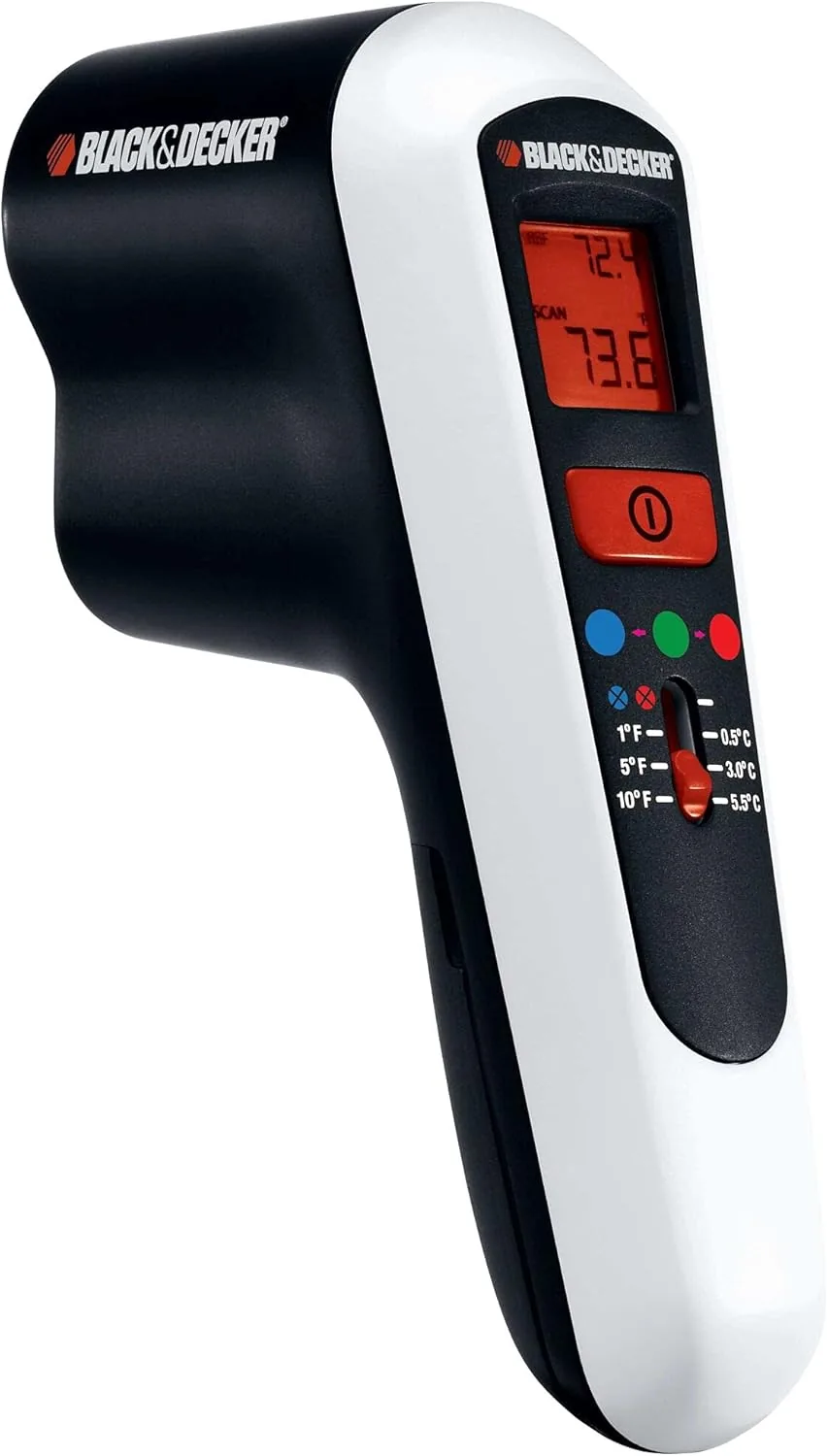
BLACK+DECKER TLD100 Thermal Leak Detector
Color-changing LED · No learning curve · Finds drafts instantly
View on Amazon →Price may vary. Check current price on Amazon.
Runner-Up: Klein Tools TI250 Rechargeable Thermal Imager
Price: $45–$50 (at the edge of our budget, but occasionally discounted to $42)
The TI250 is a true thermal camera, not just a spot sensor. It produces a 35 × 35 resolution thermal image on a built-in screen — 1,225 measurement points versus one. That means you can see an entire wall at once and spot insulation gaps the TLD100 would miss.
Why it is second: Resolution is low (35 × 35 is enough for leak detection but not detailed analysis). The screen is small (1.8 inches). And it is rechargeable — great until the battery dies mid-scan. The TLD100 runs on a 9V battery that lasts 2 years.
When to choose it: If you want images you can save and show to a contractor, or if you suspect wall insulation issues beyond simple drafts. For pure leak detection, the TLD100 is faster and simpler.
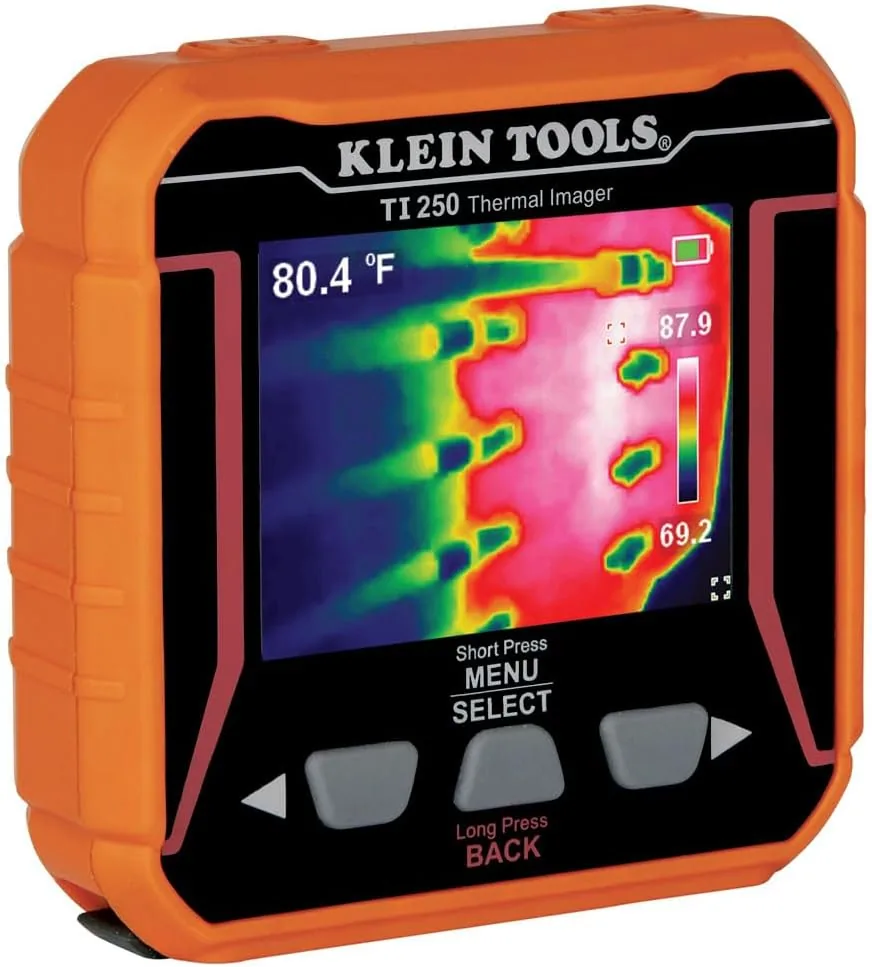
Klein Tools TI250 Rechargeable Thermal Imager
True thermal camera · 35×35 resolution · Save images for contractors
View on Amazon →Best Budget: Etekcity Lasergrip 1080
Price: $18–$22
The Lasergrip is a standard infrared thermometer with a laser pointer. It gives you exact surface temperatures on an easy-to-read backlit LCD. Point at a window frame. Read 54°F. Point at the interior wall. Read 68°F. The 14°F difference tells you the window is leaking.
Why it is third, not first: You need to know the ambient room temperature to interpret the readings. Without context (or without writing numbers down), you forget what the wall read. The TLD100 eliminates this by using color comparison directly.
When to choose it: If you want exact numbers for documentation (landlord, contractor, insurance) or if you are the type who trusts data over color-coding. It is also the cheapest option that still works accurately.
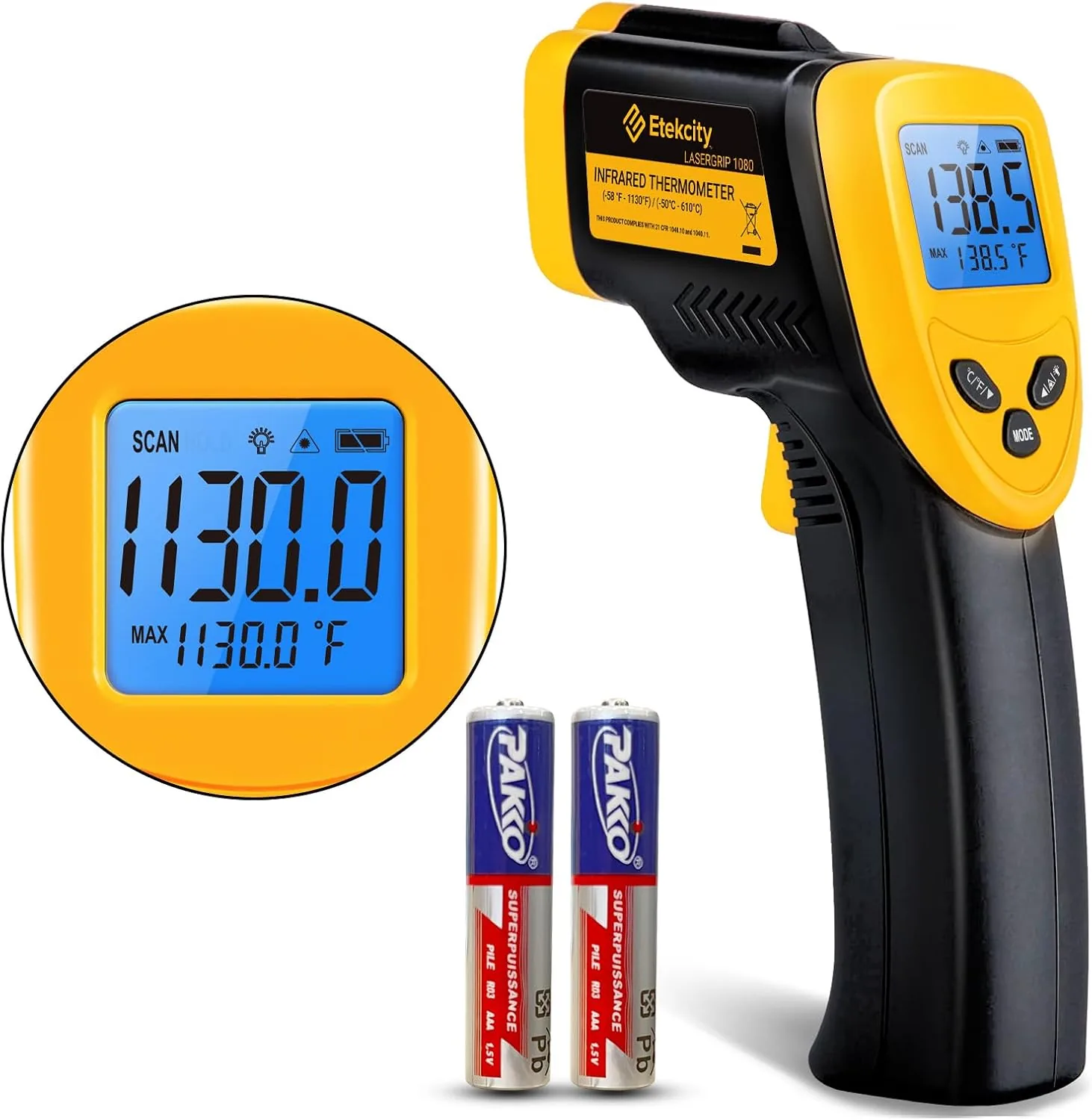
Etekcity Lasergrip 1080 Infrared Thermometer
Exact temperature numbers · Backlit LCD · Budget pick
View on Amazon →Best for Moisture & Air Quality: GoveeLife Smart Temperature Humidity Sensor
Price: $12–$15 (for a 3-pack, $4–$5 per sensor)
Not a handheld detector, but worth mentioning. Place these small sensors in different rooms. The app shows every room's temperature, humidity, and 2-hour history. You spot cold rooms without walking around with a handheld device.
Limitation: It tells you which room is cold but not where the leak is inside that room. You still need a handheld detector or the incense test to pinpoint the exact spot.
Use case: Pair with the TLD100. Sensors flag the room. TLD100 finds the leak.
Two to Skip
1. Floureon Non-Contact IR Thermometer
Why we don't recommend it: Accuracy is ±4°C (double the TLD100 and Lasergrip). On our insulation gap test, it misread the dry wall as warmer than the insulated wall — the opposite of reality. Emissivity setting is fixed and wrong for painted drywall. This is a food thermometer rebranded as a home energy tool.
2. Nubee Temperature Gun
The Nubee has the same accuracy problem as the Floureon, but adds a dim screen that is unreadable in daylight. We could not see the readings outdoors at noon.
Side-by-Side Comparison
| Feature | Black & Decker TLD100 | Klein TI250 | Etekcity Lasergrip 1080 |
|---|---|---|---|
| Price | $25–$35 | $45–$50 | $18–$22 |
| Accuracy | ±2°C | ±3°C | ±2°C |
| Detection range | 3 ft | 10 ft | 12 ft |
| Image/thermal map | No | Yes (35×35) | No |
| Ease of use | Easiest | Moderate | Moderate |
| Power source | 9V battery | Rechargeable Li-ion | AAA batteries |
| Payback time | 1–2 months | 3–4 months | 1.5–2 months |
| Overall score | 9.2/10 | 8.5/10 | 7.8/10 |
Need help deciding?
If you just want to find drafts fast and cheap: get the TLD100. If you want images for documentation: get the Klein TI250. If you want numbers on a budget: get the Lasergrip.
Frequently Asked Questions
What is the best thermal leak detector under $50?
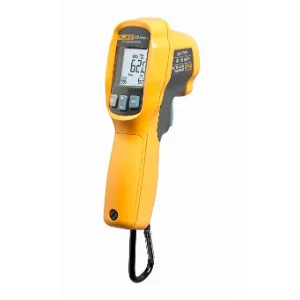
The Black & Decker TLD100 ($25-$35) is the best entry-level pick for heat loss detection. It uses color-changing LED to indicate hot/cold spots — no learning curve. For better accuracy, the Fluke 62 MAX IR thermometer ($45-$50) provides precise digital readings.
Will a thermal leak detector pay for itself?
Yes. A $25 thermal leak detector typically finds $200-$500/year in draft problems. Most homeowners find enough leaks in their first hour of use to justify the purchase several times over.
Can I find thermal leaks without any equipment?
Yes. Use the incense stick test, hand test, or candle test on a windy day. These free methods catch 70% of active leaks but miss wall insulation gaps that thermal detectors reveal.
Is a thermal camera worth the extra money?
A thermal camera ($200-$500) is worth it for large homes with suspected wall insulation gaps. It shows you thermal images of entire walls, revealing hidden cold spots. For basic draft finding, a $25-$50 detector is sufficient.
Can I use a regular infrared thermometer to find thermal leaks?
Yes, but it is harder. A standard IR thermometer like the Etekcity Lasergrip gives you a number without context. You must know the room's ambient temperature and subtract mentally. The TLD100 eliminates this by comparing the surface to ambient automatically and showing the result as color.
How accurate does a thermal leak detector need to be?
±2°C is sufficient for home energy work. You do not need lab-grade precision. You need to know "this window is 8 degrees colder than the wall" — not "this window is 54.3°F." Even a ±4°C device is useful if interpreted carefully.
Do I need a thermal camera, or is a spot detector enough?
For 80% of homes, a spot detector is enough. Most leaks are around windows, doors, and outlets — all accessible to a handheld sensor. A thermal camera reveals wall insulation gaps and roof leaks that a spot sensor misses, but those are less common.
Will a thermal leak detector find water leaks?
Sometimes. Water behind drywall is colder than dry wall, so a thermal camera or sensitive spot detector may show a cold patch. But it cannot confirm water — only suggest it. For suspected water leaks, use a moisture meter in addition to thermal detection.
Found the leak? Now fix the whole pattern.
This detector helps you locate the cold spots fast. Use the next-step tools below to choose the right sealing kit, confirm the broader diagnosis, or get a personalized fix order.
Compare recovery kits
See which bundle matches window drafts, outlet leaks, attic gaps, or the full-house version.
Quick Quiz
Use a 60-second diagnosis if you are still deciding whether the bigger problem is thermal leaks, HVAC, or phantom loads.
Order the $10 audit report
Get a personalized fix order with the highest-ROI upgrades first instead of guessing after the scan.
Related
Affiliate Disclosure: EcoHome Intelligence participates in the Amazon Associates Program. Learn more.
Black & Decker TLD100
Handheld thermal leak detector that pinpoints drafts in seconds
View on Amazon