EcoGuide · Heating · Updated 2026-11-07 · 1,900 words
The Most Energy-Efficient Space Heater: What Actually Lowers the Cost
Our picks at a glance
Prices on Amazon change often. As an Amazon Associate we earn from qualifying purchases, at no extra cost to you.
The Short Answer
Every plug-in electric heater turns electricity into heat at 95 to 100% efficiency, according to the U.S. Department of Energy (DOE). A 1,500-watt ceramic, oil-filled or “infrared” heater uses the same 1.5 kWh in an hour at full power. So the heater that costs least to run is the one that runs least: a good thermostat, the lowest wattage that keeps you warm, and heat aimed at you rather than the whole house.
| Pick | Best for | Watts | What cuts the running cost | Amazon price* |
|---|---|---|---|---|
| DREO Atom One Space Heater Check price › | Most rooms | 1,500 | Digital thermostat in 1°F steps, ECO mode, 12-hour timer | $44.93 |
| De’Longhi EW7707CM Oil-Filled Radiator Check price › | Quiet rooms you sit in for hours | 1,500 | Oil holds heat, so it cycles less; ComfortTemp mode | $129.95 |
| Vornado VH202 Personal Heater Check price › | One person at a desk | 750 / 375 | Half (or a quarter) of a full-size heater’s draw | $34.99 |
| Dr Infrared Heater DR-968 Check price › | Larger rooms | 1,500 | Thermostat from 50 to 85°F, Eco setting, 12-hour shut-off | $104.00 |
Product links go to Amazon; we may earn a commission at no extra cost to you.
Our pick for most homes: the DREO Atom One, because a precise thermostat is what stops a heater from running flat out all evening, and it has the tip-over switch and safety listing that DOE and CPSC advise. For a quiet room you sit in for hours, such as a home office or a bedroom before bed, the oil-filled De’Longhi is silent. If you only need to warm yourself at a desk, the Vornado VH202 costs half as much per hour.
*Prices as listed on Amazon for delivery to Los Angeles on November 1, 2026 (the DREO on November 4, the Dr Infrared on November 7); heaters go on sale often from November. We compared maker and retailer specifications; we do not test products in-house (how we choose). Sources are listed at the end.
What a Space Heater Really Costs to Run
Running cost is watts ÷ 1,000 × hours × your price per kWh. At 18.31 cents per kWh, the U.S. residential average the Energy Information Administration reported for July 2026:
| Setting | Per hour | 8 hours a day for 30 days |
|---|---|---|
| 1,500 W (full power) | about 27¢ | 360 kWh, about $65.92 |
| 750 W (low, or a personal heater) | about 14¢ | 180 kWh, about $32.96 |
| 375 W (Vornado VH202 on low) | about 7¢ | 90 kWh, about $16.48 |
Those are worst cases: a heater with a thermostat cycles off once the room is warm, so it uses less. Put your own hours and rate into our space heater cost calculator to see your number.
What Actually Lowers the Cost
- A thermostat. DOE advises choosing a thermostatically controlled heater “because they avoid the energy waste of overheating a room” (DOE). A digital one with 1-degree steps holds the room more tightly than a dial.
- The right size. DOE also says not to buy an oversized heater. A 750-watt personal heater is enough to warm one person at a desk.
- Heating the person, not the room. DOE says radiant heat is the more efficient choice when you will be in a room for only a few hours and can stay in the heater’s line of sight.
- Turning the central heat down. A space heater only saves money if it lets you lower the thermostat for the rest of the house. DOE says space heaters can be cheaper when you only want to heat one room. Running one on top of normal central heating just adds to the bill.
- Sealing the room first. A drafty room loses the heat as fast as you add it. Our window kits and draft stoppers cost less than a month of running a heater.
For whole-house savings, a heat pump moves heat instead of making it: DOE says it can deliver two to four times more heat energy than the electricity it uses. See mini-splits for supplemental heat.
1. DREO Atom One: Best for Most Rooms
A 1,500-watt ceramic heater with a digital thermostat from 41 to 95°F in 1°F steps, an ECO mode that DREO says adjusts the heat level automatically to hold your set temperature, a 12-hour timer and 70-degree oscillation. The listing describes it as ETL-listed with tip-over and overheat protection, and as quiet as 37.5 dB.
Why it is our top pick: at under $50 it has the controls that cut running time, a precise thermostat and a timer, plus tip-over and overheat protection. The trade-off: a fan heater, so you hear it, and the heat stops as soon as it switches off.
We may earn a commission if you buy through these links, at no extra cost to you. Products are chosen on published specifications; we do not test them in-house (how we choose).
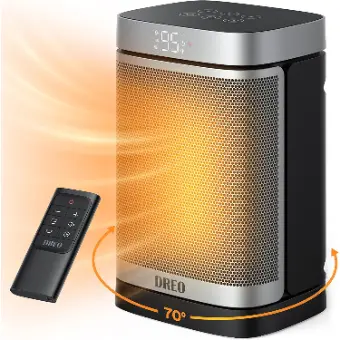
DREO Atom One Space Heater
1,500 W ceramic; digital thermostat 41–95°F in 1°F steps; ECO mode; 12-hour timer; tip-over and overheat protection.
Check price on Amazon2. De’Longhi EW7707CM: Best Quiet Heater
An oil-filled radiator with no fan, so it is silent. DOE says the best convection heaters “incorporate a heat transfer liquid, such as oil,” which stores heat so the heater cycles less and gives steadier warmth (DOE). De’Longhi says its ComfortTemp mode delivers “up to 20% more efficiency” compared with running the same heater with its thermostat at maximum, and lists a thermal cut-off and fully enclosed elements (De’Longhi).
Worth knowing: it takes several minutes to warm up, and De’Longhi itself says it suits well-insulated spaces or occasional use. Choose it for a room you use for hours at a time, not for quick bursts of warmth, and switch it off when you go to sleep, as CPSC advises for all space heaters.
We may earn a commission if you buy through these links, at no extra cost to you. Products are chosen on published specifications; we do not test them in-house (how we choose).
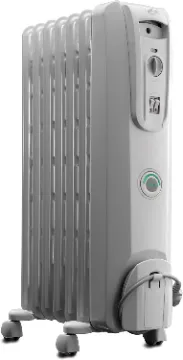
De’Longhi EW7707CM Oil-Filled Radiator
Oil-filled radiator, 1,500 W, no fan; ComfortTemp mode; thermal cut-off; adjustable thermostat.
Check price on Amazon3. Vornado VH202: Best Low-Power Personal Heater
The cheapest heater here to run, because it draws less: 750 watts on high and 375 on low, according to the retailer listing, with a fan-only setting, a tip-over switch and a cool-touch case (listing). At 18.31 cents per kWh that is about 14 cents an hour on high, half the cost of a full-size heater.
Choose it for a home office or a desk where you can turn the whole-house thermostat down a few degrees. Skip it for warming a whole room in cold weather; it is not sized for that.
We may earn a commission if you buy through these links, at no extra cost to you. Products are chosen on published specifications; we do not test them in-house (how we choose).
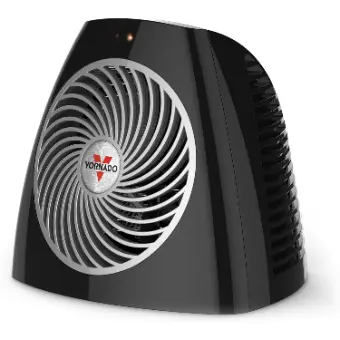
Vornado VH202 Personal Heater
750 W high / 375 W low; tip-over switch; cool-touch case; fan-only setting; sized for one person.
Check price on Amazon4. Dr Infrared DR-968: Best for Larger Rooms
A 1,500-watt heater with infrared quartz tubes and a PTC element behind a fan. The retailer listing gives an electronic thermostat from 50 to 85°F, Eco, High and Low settings, a 12-hour automatic shut-off, tip-over and overheat protection, UL and cUL listing, and coverage of up to 400 square feet (listing).
Worth knowing: “infrared” does not mean it uses less power. It draws the same 1,500 watts as any other full-size heater; what you get is a wide thermostat range and controls built for a living room or basement.
We may earn a commission if you buy through these links, at no extra cost to you. Products are chosen on published specifications; we do not test them in-house (how we choose).
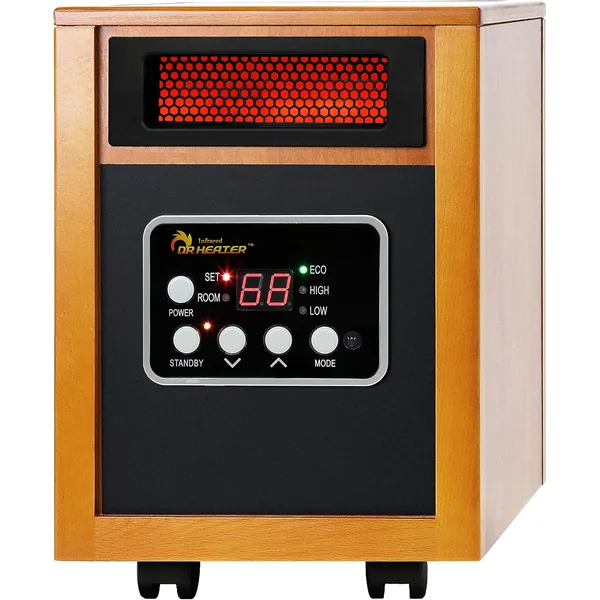
Dr Infrared Heater DR-968
1,500 W, infrared quartz plus PTC; thermostat 50–85°F; 12-hour shut-off; tip-over and overheat protection; UL listed.
Check price on AmazonUse It Safely
CPSC estimates that portable heaters are involved in an average of 1,600 fires per year (2020 to 2022). Its tips, plus DOE’s:
- Plug it directly into a wall outlet, never into an extension cord or power strip (CPSC). That also rules out a smart plug.
- Keep it at least three feet from drapes, furniture, bedding and anything else that can burn (CPSC).
- Turn it off when you go to sleep (CPSC).
- Buy one with a tip-over safety switch and a safety label, and keep children and pets away from it (DOE).
Our full checklist is on the space heater calculator page.
Free: Home Energy Audit Checklist (PDF)
A two-page, room-by-room checklist for finding air leaks, standby power and heating and cooling waste yourself, in the order that pays back fastest. Get it now, plus new fix guides by email. Unsubscribe any time.
By signing up you agree to receive emails from EcoHome Intelligence. See our Privacy Policy.
Frequently Asked Questions
What is the most energy-efficient space heater?
None, in the sense the ads suggest. DOE puts electric heating at 95 to 100% efficient, so every 1,500-watt heater uses the same 1.5 kWh an hour at full power. The cheapest to run is one with a good thermostat, the lowest wattage that keeps you warm, and heat aimed at you rather than the whole room.
Do energy-efficient space heaters really save money?
Only if they run less or draw less. A precise thermostat, a timer, a lower-wattage personal heater and turning the central heat down are what lower the bill. A heater labeled energy-efficient still uses 1.5 kWh an hour at 1,500 watts.
Is an oil-filled heater cheaper to run than a ceramic heater?
At the same wattage and runtime, no. DOE says oil-filled heaters store heat and cycle less, which gives steadier warmth, so in a room you heat for hours the thermostat may keep it on for less of the time.
How much does it cost to run a space heater all day?
At 1,500 watts it uses 1.5 kWh an hour, about 27 cents at 18.31 cents per kWh, EIA’s U.S. average for July 2026. Eight hours a day for a month at full power is about $65.92. A 750-watt personal heater costs about half that.
Is an infrared heater more efficient?
Not in electricity use: a 1,500-watt infrared heater draws the same power as any other. DOE says truly radiant heat can be the more efficient choice when you are in a room for only a few hours and stay in the heater’s line of sight, because it warms you rather than the air.
Related Guides
- Electric blanket vs space heater — the cheaper way to stay warm in bed
- Black Friday 2026 energy-saving deals — prices to beat on monitors, plugs and heaters
- Space heater cost calculator — your hours, your rate
- Mini-splits for supplemental heat — the efficient way to heat one room
- Window kits and draft stoppers — keep the heat in the room
- Why is my electric bill so high in winter? — the bigger causes
- Best thermal curtains for winter — keep the heat in the room
Sources
- U.S. DOE: Home heating systems fact sheet (PDF)
- U.S. DOE Energy Saver: Small space heaters (archived March 2026)
- U.S. DOE Energy Saver: Air-source heat pumps (archived June 2026)
- EIA: Electric Power Monthly, average retail price by end-use sector
- CPSC: Tips for using generators, furnaces and space heaters (January 2026)
- De’Longhi: ComfortTemp Full Room Radiant Heater EW7707CM
- Ace Hardware: Vornado VH202 listing
- Tractor Supply: Dr Infrared DR-968 listing
