EcoGuide · EV Charging · Published 2026-11-14 · 1,600 words
The Best Level 2 Home EV Charger: Which One Fits Your Panel and Your Car
Check today’s prices
Prices on Amazon change often. As an Amazon Associate we earn from qualifying purchases, at no extra cost to you.
The Short Answer
A Level 2 charger runs on 240 volts, like a dryer, and charges an EV several times faster than the 120-volt cord that comes with the car. You may not need one: the U.S. Department of Energy says many drivers meet their daily needs by charging overnight on Level 1, and that Level 2 suits less regular schedules, longer commutes and large batteries (DOE AFDC). If you do, the right charger depends on three things: the connector on your car, how many amps your electrical panel can spare, and whether you want it plugged in or hardwired.
- Most power, most flexible: ChargePoint Home Flex. Settings from 16 to 50 amps (up to 12 kW), a 23 ft cable, UL listed and ENERGY STAR certified (ChargePoint). $549 on Amazon on November 14.
- Best value smart charger: Emporia 48A. Up to 48 amps (11.5 kW at 240 V), a 25 ft cable, and an app that can sync to your utility’s rates and charge in low-cost hours (Emporia). $499 on Amazon on November 14.
- Best plug-in for NACS (Tesla-style) cars: Grizzl-E Classic Connect. 40 amps from a NEMA 14-50 plug, a NACS connector, Wi-Fi scheduling and an aluminum case (Grizzl-E). $299.99 on Amazon on November 14.
| ChargePoint Home Flex | Emporia 48A | Grizzl-E Classic Connect | |
|---|---|---|---|
| Connector (this listing) | J1772 | J1772 | NACS |
| Installation (this listing) | Hardwired | Hardwired, with whip | NEMA 14-50 plug |
| Max current / power | 50 A / 12 kW | 48 A / 11.5 kW | 40 A / 9.6 kW at 240 V |
| Adjustable down to | 16 A | see manual | 16 A |
| Cable | 23 ft | 25 ft | 25 ft |
| Outdoor rating | NEMA 3R | NEMA Type 4 | UL Type 4 |
| Listed / certified (maker) | UL; ENERGY STAR | UL 2594; ENERGY STAR | UL/cUL |
| App scheduling | Yes | Yes, synced to utility rates | Yes |
| Warranty | 3 years | 3 years | 3 or 5 years (option) |
| Amazon, Nov 14, 2026 | $549.00 | $499.00 | $299.99 |
Specifications from the makers’ own pages, checked November 14, 2026: ChargePoint, Emporia sell sheet and Grizzl-E. Amazon prices and listing details checked by hand on November 14, 2026, each sold by the brand’s own Amazon store. We compare published specifications and do not test products in-house (how we choose).
Before You Buy: Amps, Breakers and Your Panel
An EV charger is a continuous load under the National Electrical Code, which DOE notes, so it needs a circuit rated above what the charger draws (DOE AFDC). The makers spell out the pairing:
- Emporia: a dedicated 50 A double-pole breaker for 40 A charging, 60 A for 48 A (Emporia).
- ChargePoint: plug-in installation only on 40 A or 50 A circuits, for 32 A or 40 A charging; anything else is hardwired (ChargePoint FAQ).
- Charging speed is roughly the charger’s power in kW times hours: at 11.5 kW, about 11.5 kWh an hour, if your car’s onboard charger accepts that much. Many cars accept less, so a 40 A charger may charge them as fast as a 50 A one.
Plug-in or hardwired? A plug-in charger is easy to move, but Emporia says a NEMA 14-50 outlet must be industrial-grade and rated for continuous duty at 50 A, and that standard residential outlets are not suitable for daily EV charging. Both Emporia and ChargePoint say their chargers have built-in ground-fault protection and suggest a hardwired install where code requires a GFCI breaker, to avoid nuisance trips. Either way, DOE recommends a certified electrical contractor and notes that permits may be required.
1. ChargePoint Home Flex: Most Power, Most Flexible
The widest range of settings here: 16, 24, 32, 40, 48 or 50 amps, set in the app, for up to 12 kW at 240 V; a 23 ft cable; a NEMA 3R weatherproof rating for outdoor installs; UL listing, ENERGY STAR certification and a 3-year warranty (ChargePoint, ChargePoint). ChargePoint sells it with a J1772 or a NACS connector, as a hardwired unit or with a NEMA 6-50 or 14-50 plug.
Choose it if you want headroom: if your panel can spare a large circuit, it charges at up to 50 A, and if it cannot, an electrician can set it as low as 16 A. Know before you buy: this listing is the hardwired J1772 version, so it needs an electrician, and it is the priciest of the three.
We may earn a commission if you buy through these links, at no extra cost to you. Products are chosen on published specifications; we do not test them in-house (how we choose).
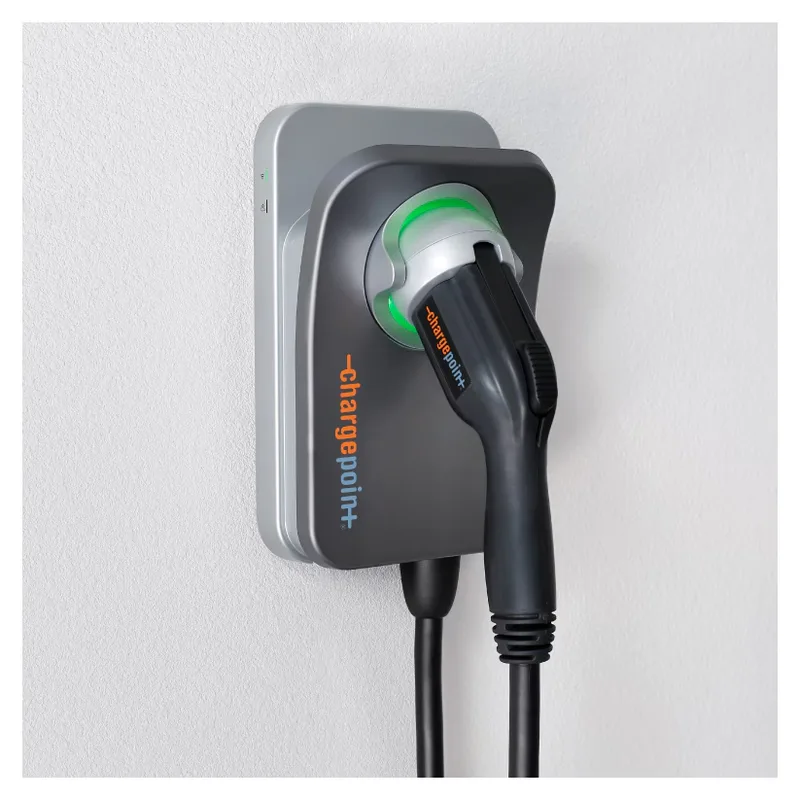
ChargePoint Home Flex (J1772, hardwired)
16–50 A (up to 12 kW); 23 ft cable; NEMA 3R; UL, ENERGY STAR; 3-year warranty. $549 on Amazon on Nov 14, 2026.
Check price on Amazon2. Emporia 48A: Best Value Smart Charger
Up to 48 A hardwired (11.5 kW at 240 V), or 40 A with its NEMA 14-50 plug version, a 25 ft cable, a NEMA Type 4 enclosure rated for indoor or outdoor use, UL 2594 safety certification, ENERGY STAR, and a 3-year warranty (Emporia sell sheet). Its app can sync to your utility rates to charge automatically during low-cost hours, or follow a schedule you set (Emporia).
Choose it if you are on a time-of-use rate: shifting charging to cheap hours is where the savings are. To see what charging adds to your bill, pair any charger with a home energy monitor. Know before you buy: this Amazon listing is the hardwired version with a whip, so plan for an electrician. Emporia’s pages do not describe charging from surplus solar, so we do not claim it.
We may earn a commission if you buy through these links, at no extra cost to you. Products are chosen on published specifications; we do not test them in-house (how we choose).
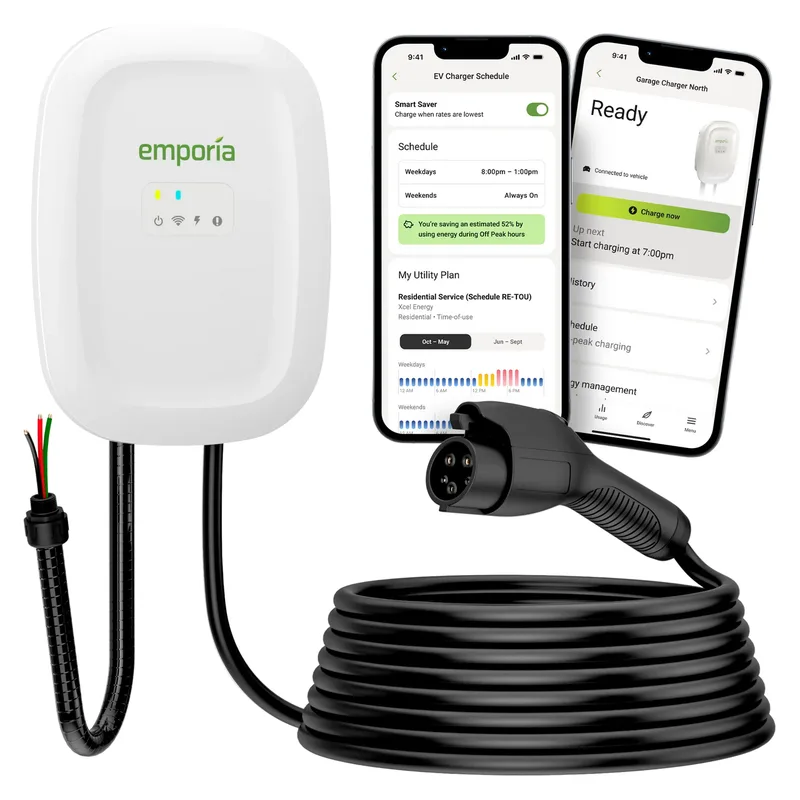
Emporia Level 2 EV Charger (J1772, 48A, hardwired)
Up to 48 A (11.5 kW); 25 ft cable; NEMA Type 4; UL 2594, ENERGY STAR; utility-rate scheduling. $499 on Amazon on Nov 14, 2026.
Check price on Amazon3. Grizzl-E Classic Connect: Best Plug-In for NACS Cars
A 40 A charger, adjustable down to 16 A, with a NEMA 14-50 plug, a 25 ft cable, an aluminum enclosure with a UL Type 4 indoor/outdoor rating, UL/cUL listing, and Wi-Fi with an app to schedule charging, monitor sessions and track costs (Grizzl-E). Grizzl-E describes it as Canadian-made; its page offers a 3- or 5-year warranty.
Choose it if your car has a NACS (Tesla-style) charge port and you already have, or can have installed, a proper 50 A NEMA 14-50 outlet. At 40 A it is 9.6 kW at 240 V. Know before you buy: this listing has a NACS connector; for a J1772 car, choose the J1772 version instead.
We may earn a commission if you buy through these links, at no extra cost to you. Products are chosen on published specifications; we do not test them in-house (how we choose).
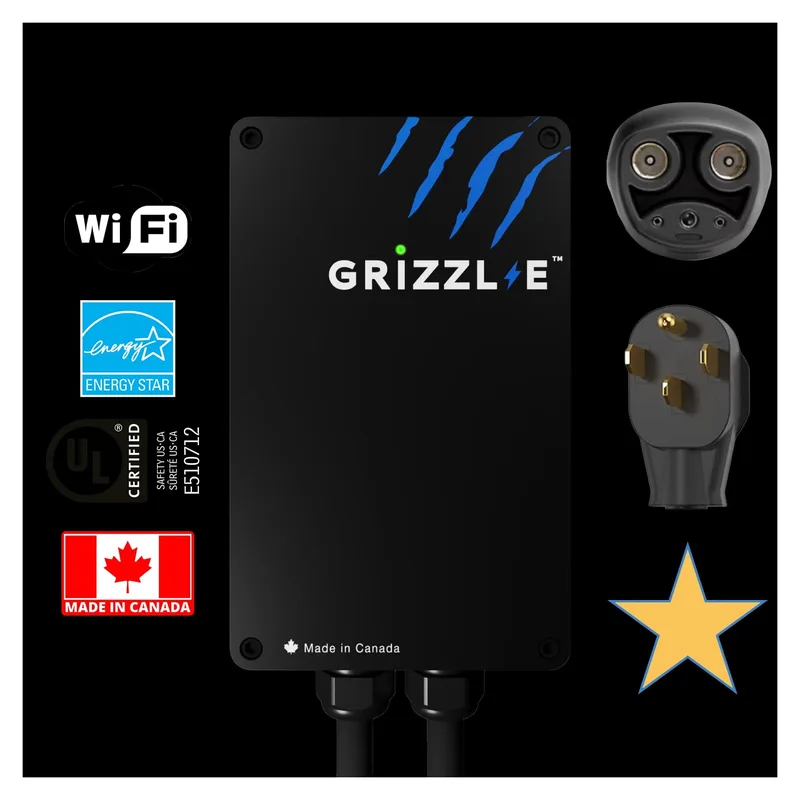
Grizzl-E Classic Connect 40A (NACS, NEMA 14-50)
40 A (9.6 kW at 240 V); NEMA 14-50 plug; NACS; 25 ft cable; Wi-Fi scheduling; UL/cUL. $299.99 on Amazon on Nov 14, 2026.
Check price on AmazonWhat Charging at Home Costs
The charger does not set the price of your electricity; your utility does. Each kWh you put in the car costs your rate: the U.S. residential average was 18.31 cents per kWh in July 2026, according to EIA, so 10 kWh is about $1.83 at that rate. DOE notes that some utilities offer time-of-use rates or other incentives for EV owners, which is where a scheduling app pays off (DOE AFDC).
Free: Home Energy Audit Checklist (PDF)
A two-page, room-by-room checklist for finding air leaks, standby power and heating and cooling waste yourself, in the order that pays back fastest. Free to download, no sign-up needed.
Download the checklist (PDF)Frequently Asked Questions
Do I need a Level 2 charger?
Not always. DOE says many drivers meet their daily needs charging overnight on the Level 1 cord that comes with the car. Level 2 makes sense for longer commutes, irregular schedules or large batteries.
What size breaker do I need for a 48 amp EV charger?
A dedicated 60 A double-pole breaker, according to Emporia; 40 A charging needs a 50 A breaker. Have a licensed electrician confirm your panel has the capacity.
Should I choose J1772 or NACS?
Match your car’s charge port. J1772 and NACS (also called SAE J3400) are different plugs; ChargePoint, Emporia and Grizzl-E each sell both versions.
Is a plug-in or hardwired EV charger better?
Hardwired allows the highest currents; ChargePoint allows plug-in only on 40 A or 50 A circuits. Plug-in is easier to move. Emporia says a plug-in needs an industrial-grade 14-50 outlet rated for continuous duty.
Can these chargers charge from solar?
None of the three makers’ pages describes charging from surplus solar. Scheduling charging for midday on a time-of-use plan is possible with their apps, but that is a schedule, not solar tracking.
Related Guides
- Best home energy monitors — see the charger on your bill
- Refoss vs Emporia Vue vs Sense — which monitor to pair
- Best portable power station — backup for the house, not the car
- Solar panels but the bill is still high — where solar fits
Sources
- ChargePoint: Home Flex Hardwired (store, specifications)
- ChargePoint: Home Flex installation FAQ
- ChargePoint: Home Flex overview
- Emporia: Level 2 EV charger product page
- Emporia: Classic EV charger sell sheet (PDF)
- Grizzl-E: Classic Connect 40A
- U.S. DOE Alternative Fuels Data Center: Charging electric vehicles at home
- EIA: Electric Power Monthly, average retail price by end-use sector