EcoGuide · Home Backup · Updated 2026-11-20 · 1,800 words
The Best Portable Power Station for Home Backup
Check today’s prices
Prices on Amazon change often. As an Amazon Associate we earn from qualifying purchases, at no extra cost to you.
The Short Answer
A portable power station is a battery with outlets: it keeps a refrigerator, a CPAP machine, a modem and phones running through an outage, then recharges from the wall or solar panels. It is not a whole-home battery. All three picks here put out 120 volts from standard outlets, so they cannot run 240-volt loads such as central air, an electric range or most well pumps.
- Best for most homes: Anker SOLIX C1000 Gen 2. 1,024 Wh, 2,000 W of output, a 10-millisecond UPS switchover and a full recharge in 49 minutes, according to Anker. It cannot take an extra battery.
- Most capacity: EcoFlow DELTA 2 Max. 2,048 Wh, 2,400 W, up to 1,000 W of solar input, and EcoFlow says it expands to 6,144 Wh with two extra batteries (EcoFlow). At 50 lb it is a move-once machine.
- Lightest: Jackery Explorer 1000 v2. About 23.8 lb for roughly 1 kWh and 1,500 W, with 400 W of solar input (Jackery). On Amazon on November 20 it cost $89 more than the Anker ($559.00 against $469.99).
| Anker SOLIX C1000 Gen 2 | EcoFlow DELTA 2 Max | Jackery Explorer 1000 v2 | |
|---|---|---|---|
| Capacity | 1,024 Wh | 2,048 Wh | 1,070 Wh (spec sheet) |
| AC output (surge) | 2,000 W (3,000 W) | 2,400 W (4,800 W) | 1,500 W (3,000 W) |
| AC outlets (120 V) | 5 | 6 | 3 |
| Max solar input | 600 W, 11–60 V | 1,000 W (2 × 500 W), 11–60 V | 400 W, 12–60 V |
| Fastest wall recharge | 100% in 49 min (UltraFast, in the app) | 80% in 1.1 h | 1.58 h (50 min emergency mode) |
| UPS switchover | 10 ms | under 20 ms | under 20 ms |
| Rated cycles | 4,000 to 80% | 3,000 to 80% | 4,000 to 70% |
| Extra battery | No | Yes, up to 2 | Not listed |
| Weight | 24.9 lb | 50 lb | about 23.8 lb |
| Warranty | 5 years | 5 years | 3+2 years |
| Amazon, Nov 20, 2026 | $469.99 | $977.00 | $559.00 |
Specifications from each maker’s own product page, checked November 14, 2026: Anker, EcoFlow and Jackery. Amazon prices checked by hand on November 20, 2026, during Amazon’s Black Friday sale, all sold by the brand’s own Amazon store; they change often, so check the listing, including whether a solar panel is in the box. We compare published specifications and do not test products in-house (how we choose).
How Long Will It Run? The Honest Math
Runtime is capacity in watt-hours divided by what you plug in, in watts. That gives a ceiling, not a promise: turning the battery’s DC power into 120-volt AC costs some energy, and the station’s own electronics use a little more, so real runtimes are shorter. The makers do not publish one common efficiency figure, so we do not invent one. Use these as upper limits:
| Steady load | Anker C1000 Gen 2 | EcoFlow DELTA 2 Max | Jackery 1000 v2 |
|---|---|---|---|
| 40 W (Anker’s own CPAP example) | under 25.6 h | under 51.2 h | under 26.8 h |
| 100 W (a modem, lights and phones) | under 10.2 h | under 20.5 h | under 10.7 h |
| 1,000 W (a kettle or microwave, briefly) | under 1.0 h | under 2.0 h | under 1.1 h |
A refrigerator does not draw a steady load: its compressor cycles on and off, so measure yours with a plug-in meter before you size a battery (see smart plugs with energy monitoring). It also buys you time on its own: an unopened refrigerator keeps food safe for up to 4 hours and a full freezer for about 48, according to FoodSafety.gov. Running the fridge for a few hours at a time from a 1 kWh station stretches it much further than leaving it plugged in all day.
What not to run on one: a 1,500-watt space heater. It would empty the Jackery or the Anker in well under an hour, and even the EcoFlow in under two. For warmth in an outage, an electric blanket uses far less power; see electric blanket vs space heater.
1. Anker SOLIX C1000 Gen 2: Best for Most Homes
The most output for the size: 2,000 W continuous and 3,000 W peak from five 120-volt outlets, plus two 140 W USB-C ports, all from a 24.9 lb box (Anker). It recharges from the wall at 1,200 W normally, or at 1,600 W in the app’s UltraFast mode, which Anker says fills it in 49 minutes; Anker adds that UltraFast only works when the battery is above 68°F and advises using it only when needed to prolong battery life.
Why it is our pick for most homes: a 10 ms UPS switchover is the fastest here, which matters for a CPAP or a desktop computer that should not notice a blackout, and Anker rates the battery for 4,000 cycles to 80% with a 5-year warranty. Its app also has a time-of-use mode that charges when power is cheap. The trade-off: Anker’s own FAQ says it cannot take an expansion battery, so 1,024 Wh is all you will ever have; solar input tops out at 600 W.
We may earn a commission if you buy through these links, at no extra cost to you. Products are chosen on published specifications; we do not test them in-house (how we choose).
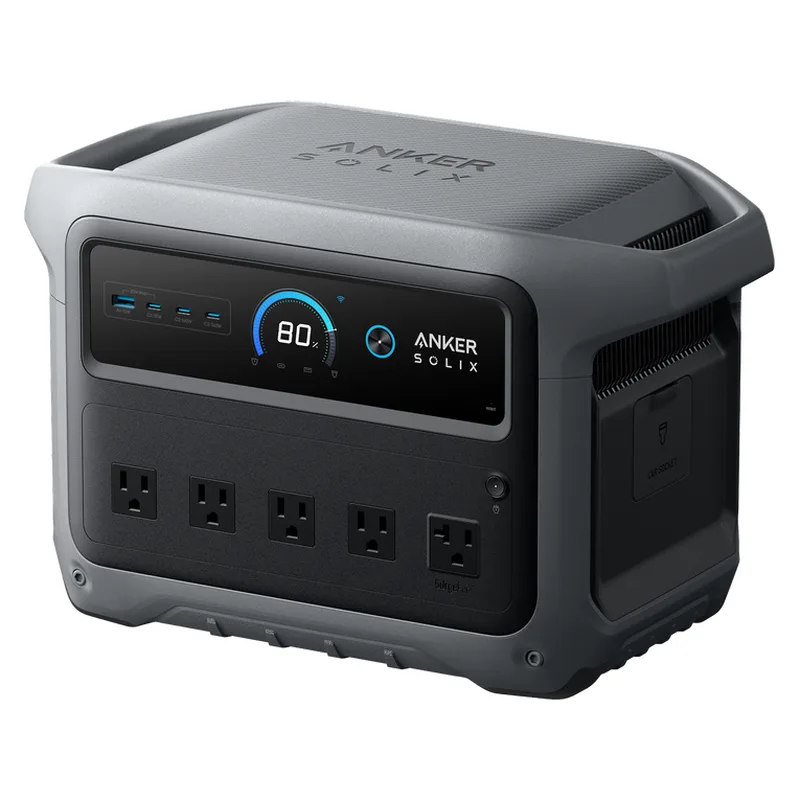
Anker SOLIX C1000 Gen 2 Portable Power Station
1,024 Wh; 2,000 W (3,000 W peak); 10 ms UPS; 600 W solar input; 5-year warranty. $469.99 on Amazon on Nov 20, 2026.
Check price on Amazon2. EcoFlow DELTA 2 Max: Most Capacity
Twice the battery of the other two: 2,048 Wh of LFP (lithium iron phosphate) cells rated for 3,000 cycles to 80%, six AC outlets with 2,400 W of output and 4,800 W of surge (EcoFlow). EcoFlow’s X-Boost mode lets some higher-wattage devices run at up to 3,400 W at reduced power. It has two solar inputs of 500 W each, which EcoFlow says recharge it in about 2.3 hours with 1,000 W of panels, and it charges from the wall at up to 1,800 W, 80% in 1.1 hours (EcoFlow).
Choose it if you want to run a refrigerator and a few small loads through a long outage, or you plan to add capacity: EcoFlow says up to two DELTA 2 Max Smart Extra Batteries take it to 6,144 Wh. Skip it if you need to carry it often: it weighs 50 lb. Its UPS switchover is under 20 ms, slower than the Anker’s.
We may earn a commission if you buy through these links, at no extra cost to you. Products are chosen on published specifications; we do not test them in-house (how we choose).
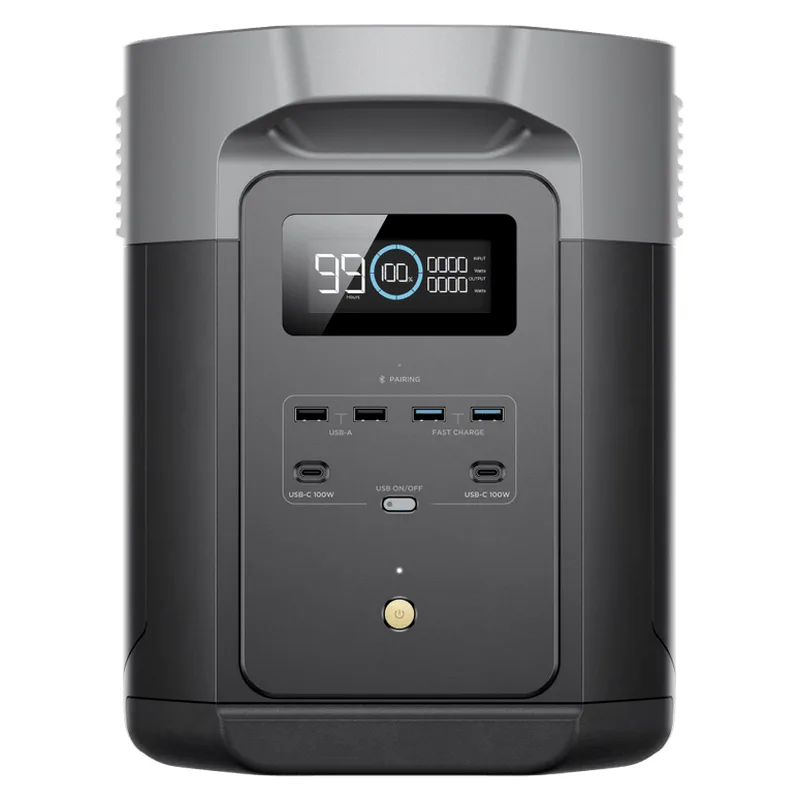
EcoFlow DELTA 2 Max Portable Power Station
2,048 Wh LFP; 2,400 W (4,800 W surge); 1,000 W solar input; expandable to 6,144 Wh; 5-year warranty. $977.00 on Amazon on Nov 20, 2026.
Check price on Amazon3. Jackery Explorer 1000 v2: Lightest 1 kWh Pick
Jackery calls it the smallest 1 kWh LFP station: about 23.8 lb and 12.9 × 8.8 × 9.7 inches, with LiFePO4 cells rated for 4,000 cycles to 70%, three 120-volt outlets with 1,500 W of output and 3,000 W of surge, a 100 W USB-C port and a car port (Jackery). Jackery’s spec sheet lists the capacity as 1,070 Wh, while its headline figure is 1,024 Wh.
Choose it if you want the lightest unit for occasional outages and camping. Know before you buy: 1,500 W of output and three outlets are the least here, solar input is limited to 400 W across two 8 mm DC ports, and the normal wall recharge takes 1.58 hours (the 50-minute figure is an emergency mode). Jackery lists the warranty as 3+2 years.
We may earn a commission if you buy through these links, at no extra cost to you. Products are chosen on published specifications; we do not test them in-house (how we choose).
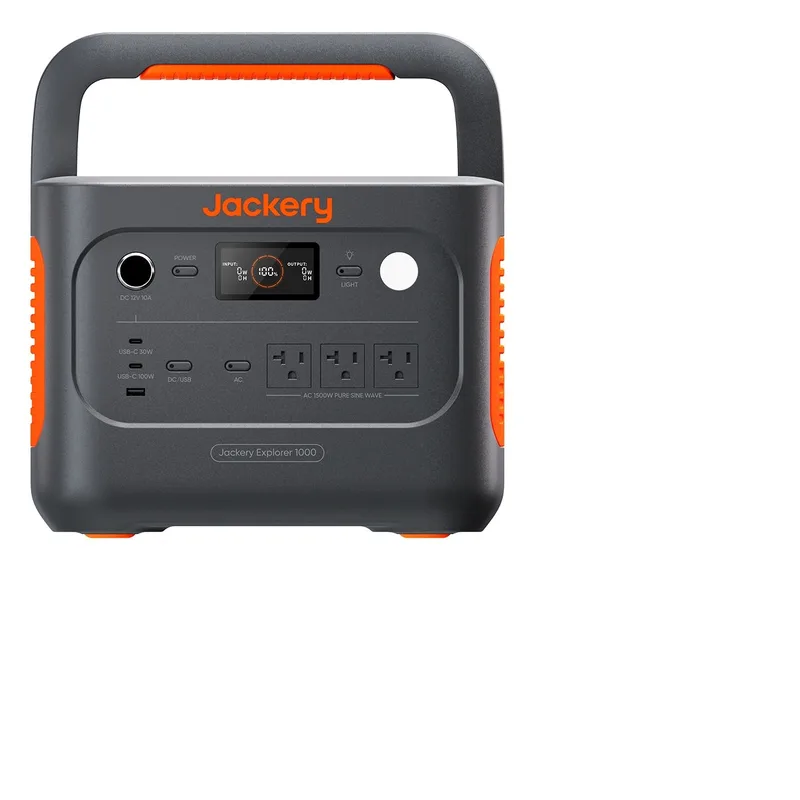
Jackery Explorer 1000 v2 Portable Power Station
About 1 kWh LiFePO4; 1,500 W (3,000 W surge); under 20 ms UPS; 400 W solar input; 23.8 lb. $559.00 on Amazon on Nov 20, 2026.
Check price on AmazonHow to Choose
- Add up the watts you must run at the same time. The station’s continuous AC rating must cover that total, and its surge rating must cover motor start-ups such as a refrigerator compressor.
- Then size the watt-hours for how long you need them, using the ceiling math above and leaving a margin.
- For medical devices or computers, look at the UPS switchover time. Under 20 ms is common; the Anker’s 10 ms is the fastest here. For a CPAP, ask your equipment supplier which backup it recommends.
- For solar, match the panel’s voltage to the station’s input range (11 or 12 to 60 V on all three) and do not exceed the stated wattage. Panels are usually sold separately.
- Do not connect a station to your home’s wiring through an outlet. Powering household circuits takes a proper transfer switch installed by a licensed electrician.
Free: Home Energy Audit Checklist (PDF)
A two-page, room-by-room checklist for finding air leaks, standby power and heating and cooling waste yourself, in the order that pays back fastest. Free to download, no sign-up needed.
Download the checklist (PDF)Frequently Asked Questions
Can a portable power station run a refrigerator?
Yes, all three have enough output. How long depends on your fridge: its compressor cycles, so measure it with a plug-in energy meter and divide the station’s watt-hours by its average draw. An unopened fridge keeps food safe for up to 4 hours without power, according to FoodSafety.gov, so running it for a few hours at a time stretches the battery.
Can a portable power station power a whole house?
No. These three output 120 volts from outlets and hold about 1 to 2 kWh, so they cannot run 240-volt loads such as central air, an electric range or most well pumps, and a home uses far more energy than that in a day.
Which portable power station charges fastest?
Of these three, the Anker SOLIX C1000 Gen 2: Anker says 100% in 49 minutes in its UltraFast mode, enabled in the app. The EcoFlow DELTA 2 Max reaches 80% in 1.1 hours, and the Jackery Explorer 1000 v2 takes 1.58 hours normally.
Do portable power stations come with solar panels?
Not usually. The makers sell bundles with panels, but the base units do not include them. Check the Amazon listing’s title and the “in the box” list before you buy.
Can I run a space heater on a portable power station?
Technically, for a short time; practically, no. A 1,500-watt heater would drain a 1 kWh station in under an hour. An electric blanket draws far less power.
Related Guides
- Black Friday power station prices — last year's lows to beat
- Best 12V LiFePO4 batteries — for a built-in RV or van system
- Best small solar panel kits — panels that fit these stations
- Electric blanket vs space heater — staying warm on less power
- Smart plugs with energy monitoring — measure what your fridge really draws
- Black Friday 2026 energy-saving deals — prices to beat
- Best home energy monitors — see your home’s loads circuit by circuit
- Most energy-efficient space heater — what really lowers the cost