EcoGuide · Solar & Storage · Published 2026-11-14 · 1,500 words
The Best 12V 100Ah LiFePO4 Battery for RVs, Vans and Small Solar Systems
Check today’s prices
Prices on Amazon change often. As an Amazon Associate we earn from qualifying purchases, at no extra cost to you.
The Short Answer
All three are 12.8-volt, 100-amp-hour lithium iron phosphate (LiFePO4) batteries, so each stores about 1,280 Wh and has a 100 A battery management system (BMS). What separates them is what happens in the cold, whether you can see the battery’s state on your phone, and the size of the case. The one rule that matters most: lithium batteries must not be charged below freezing unless they protect or heat themselves, and the three handle that very differently.
- Best for cold weather: Renogy Core Mini with DuoHeat. Built-in heating pads switch on at 41°F while it charges, so Renogy says it charges down to −22°F; Group 22NF size, IP65 (Renogy). $352.99 on Amazon on November 14.
- Best value with Bluetooth: ECO-WORTHY 100Ah. Bluetooth 5.0 to check voltage, current and charge from your phone, and a low-temperature cutoff; Group 24 size (ECO-WORTHY). $209.99 on Amazon on November 14.
- Best for mild climates: LiTime 100Ah Group 31. Rated for 4,000 cycles at 100% depth of discharge, IP65, and a 5-year warranty, but no low-temperature protection: LiTime says to charge it only above 32°F (LiTime). $302.39 on Amazon on November 14.
| Renogy Core Mini DuoHeat | ECO-WORTHY 100Ah | LiTime 100Ah | |
|---|---|---|---|
| Energy | 12.8 V × 100 Ah, about 1,280 Wh | 1,280 Wh | 1,280 Wh |
| BMS (continuous) | 100 A; 300 A peak for 10 s | 100 A | 100 A |
| Cold charging | Self-heats from 41°F (needs 10 A charge current) | Cuts off charging below 19.4°F | No protection; charge above 32°F only |
| Bluetooth | No (external monitor sold separately) | Yes | No (separate Bluetooth version) |
| Cycle rating (maker) | 5,000 at 80% depth of discharge | Not stated | 4,000 at 100% depth of discharge |
| Series / parallel | Up to 4S4P | Up to 4S4P | Up to 4S4P |
| Case size | Group 22NF, 9.0 × 5.4 × 8.4 in, 21.38 lb | Group 24, 10.2 × 6.6 × 8.4 in | Group 31, 13 × 6.77 × 8.43 in |
| Water/dust rating | IP65 | Not stated | IP65 |
| Warranty (maker) | 5 years, prorated | Not stated for this model | 5 years |
| Amazon, Nov 14, 2026 | $352.99 | $209.99 | $302.39 |
Specifications from each maker’s own product page, checked November 14, 2026: Renogy, ECO-WORTHY and LiTime. Amazon prices checked by hand on November 14, 2026, all sold by the brand’s own Amazon store; they change often. Cycle ratings are the makers’ own claims. We compare published specifications and do not test products in-house (how we choose).
How Long Will 1,280 Wh Last?
Divide the watt-hours by your load in watts for a ceiling: 1,280 Wh runs a 100 W load for under 12.8 hours and a 50 W load for under 25.6 hours. Running 120-volt appliances through an inverter costs extra energy, so real runtimes are shorter, and LiTime’s own spec sheet caps continuous output at 1,280 W, the 100 A BMS limit at 12.8 V. If you need more, all three can be wired in parallel (up to four) for more amp-hours, or in series for 24, 36 or 48 V systems, within each maker’s limits.
Plug-and-play alternative: if you only need backup power for a few appliances, a portable power station puts a similar battery, an inverter and a charger in one box.
1. Renogy Core Mini DuoHeat: Best for Cold Weather
Renogy says its DuoHeat pads (110 W) “kick in automatically at 41°F (5°C)” and turn off at 50°F, and that the battery needs at least 10 A of charging current to start heating. With that, Renogy lists a charging range of −22°F to 131°F, against the 32°F floor of a standard lithium battery. It is rated for 5,000 cycles at 80% depth of discharge, has a 100 A BMS with a 300 A peak for 10 seconds, an IP65 case, and a 5-year prorated warranty (Renogy).
Choose it if your RV, van, cabin or shed battery will be charged by solar in winter. At 21.38 lb and Group 22NF size it is also the smallest here. Know before you buy: it has no built-in Bluetooth (Renogy sells external monitors), and the heater only runs while a charger supplies at least 10 A, so a small solar panel on a dim winter day may not be enough.
We may earn a commission if you buy through these links, at no extra cost to you. Products are chosen on published specifications; we do not test them in-house (how we choose).
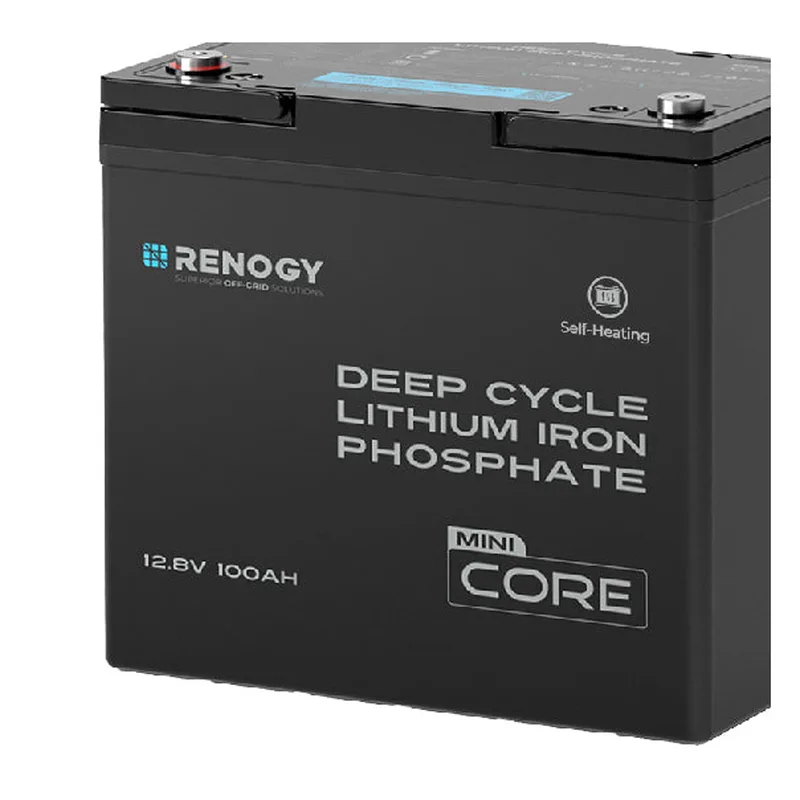
Renogy Core Mini 12V 100Ah with DuoHeat Self-Heating
1,280 Wh; self-heats from 41°F while charging (10 A minimum); 100 A BMS; IP65; Group 22NF; 5-year warranty. $352.99 on Amazon on Nov 14, 2026.
Check price on Amazon2. ECO-WORTHY 100Ah: Best Value with Bluetooth
The cheapest of the three, with Bluetooth 5.0 so you can check the battery’s voltage, current and capacity from your phone. ECO-WORTHY says its low-temperature protection cuts off charging when the cell temperature drops below 19.4°F (−7°C), and lists a 100 A maximum charge and discharge current, a 14.6 V maximum charge voltage and support for up to four in series and four in parallel (ECO-WORTHY).
Know before you buy: the same page lists a charging temperature range starting at 32°F (0°C), above the 19.4°F cutoff, so to be safe, charge it above freezing. ECO-WORTHY does not give a cycle rating or a warranty term for this model on its page, and says the cells are UL and IEC tested rather than listing a battery-level certification.
We may earn a commission if you buy through these links, at no extra cost to you. Products are chosen on published specifications; we do not test them in-house (how we choose).
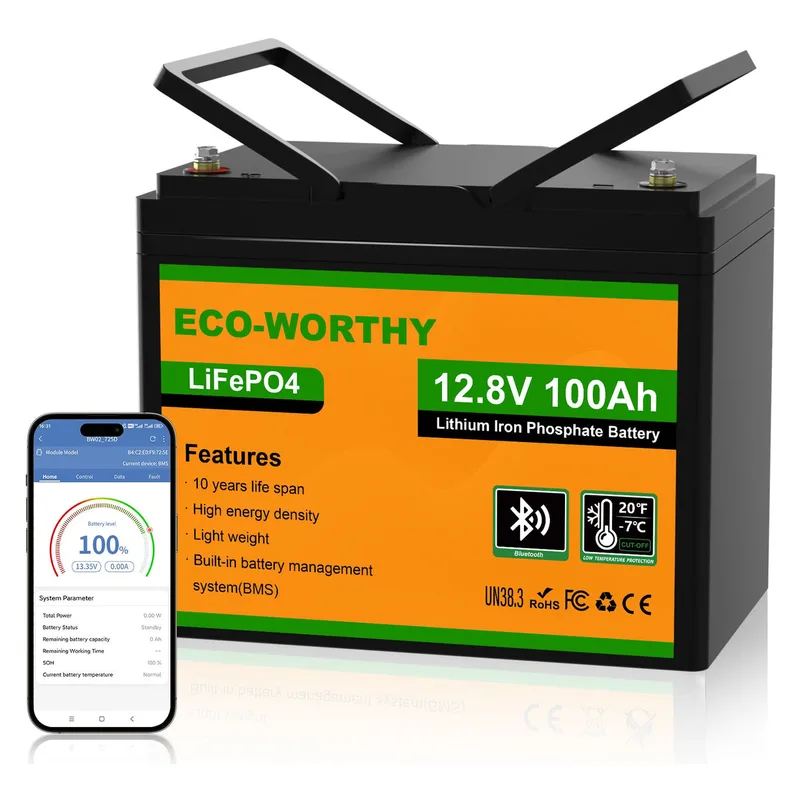
ECO-WORTHY 12V 100Ah LiFePO4 with Bluetooth
1,280 Wh; Bluetooth 5.0; low-temp charge cutoff; 100 A BMS; Group 24; up to 4S4P. $209.99 on Amazon on Nov 14, 2026.
Check price on Amazon3. LiTime 100Ah Group 31: Best for Mild Climates
LiTime rates it for 4,000 cycles at 100% depth of discharge, gives it an IP65 rating and a 5-year warranty, and lists FCC, CE, RoHS and UN38.3 certification and compliance with IEC 62619 (LiTime). It charges at up to 100 A, at 14.4 V ± 0.2 V, and supports up to four in series and four in parallel.
The catch: this model has neither low-temperature protection nor self-heating. LiTime says it should be charged only when the battery is above 32°F and that charging in freezing temperatures will damage the cells. LiTime sells separate self-heating and Bluetooth versions. Choose it for a battery that stays above freezing, such as inside a heated space, or in a warm climate.
We may earn a commission if you buy through these links, at no extra cost to you. Products are chosen on published specifications; we do not test them in-house (how we choose).
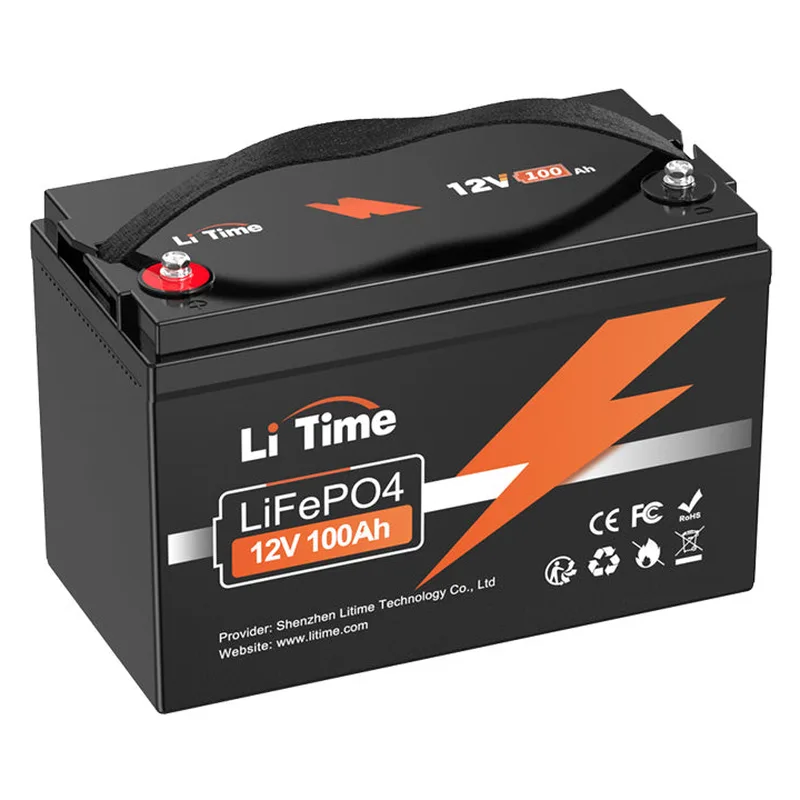
LiTime 12V 100Ah LiFePO4 (Group 31)
1,280 Wh; 100 A BMS; 4,000 cycles at 100% DoD (maker); IP65; Group 31; no low-temp protection. $302.39 on Amazon on Nov 14, 2026.
Check price on AmazonBefore You Install
- Use a LiFePO4 charging profile. Your solar charge controller, DC-DC charger or shore charger needs a lithium (LiFePO4) setting at the voltage the battery maker specifies; see our MPPT charge controller guide.
- Fuse the battery. A 100 A battery can deliver far more in a short circuit; put a correctly rated fuse or breaker close to the positive terminal, as the battery and inverter manuals specify.
- Match batteries in a bank. Use the same model and similar state of charge, and stay within each maker’s series and parallel limit.
- Respect the cold. Unless the battery heats itself, keep it above 32°F while charging.
Free: Home Energy Audit Checklist (PDF)
A two-page, room-by-room checklist for finding air leaks, standby power and heating and cooling waste yourself, in the order that pays back fastest. Free to download, no sign-up needed.
Download the checklist (PDF)Frequently Asked Questions
Can you charge a LiFePO4 battery below freezing?
Not a standard one. LiTime says its non-heated 100Ah battery should be charged only above 32°F. Batteries with self-heating, like the Renogy Core Mini DuoHeat, warm themselves first while a charger supplies current; others, like the ECO-WORTHY, cut off charging in the cold.
How many watt-hours is a 12V 100Ah lithium battery?
About 1,280 Wh: 12.8 V nominal times 100 Ah. Divide by your load in watts for a maximum runtime; an inverter reduces it.
Can I connect LiFePO4 batteries in series?
All three here allow up to four in series and four in parallel (4S4P), according to their makers. Use identical batteries and stay within those limits.
Do I need a special charger for a LiFePO4 battery?
You need a charger or solar controller with a lithium (LiFePO4) profile and the voltage the maker specifies, for example 14.4 V ± 0.2 V for the LiTime and a 14.6 V maximum for the ECO-WORTHY.
Which group size do I need?
Measure the space. The Renogy is Group 22NF (9.0 by 5.4 by 8.4 inches), the ECO-WORTHY Group 24 (10.2 by 6.6 by 8.4 inches) and the LiTime Group 31 (13 by 6.77 by 8.43 inches).
Related Guides
- Best small solar panel kits — charge these batteries
- Best MPPT solar charge controller — set up lithium charging
- Best portable power station — an all-in-one alternative
- Home energy storage — batteries and peak shaving