EcoGuide · Solar & Storage · Published 2026-11-14 · 1,800 words
The Best MPPT Solar Charge Controller for 12V and 24V Systems
Check today’s prices
Prices on Amazon change often. As an Amazon Associate we earn from qualifying purchases, at no extra cost to you.
The Short Answer
A charge controller sits between your solar panels and your battery and stops the battery from overcharging. An MPPT (maximum power point tracking) controller converts the panels’ higher voltage into extra charging current, so you can wire panels in series and use thinner cable. All three picks accept up to 100 V from the panels and work on 12 V or 24 V batteries, including lithium (LiFePO4). The two numbers to check before you buy are charge current (amps) and panel open-circuit voltage on the coldest morning; both are explained below.
- Best for most 12V systems: Renogy Rover 40A. 40 A handles up to 520 W of panels on 12 V, with an LCD screen, a remote battery temperature sensor in the box and a 3-year warranty (Renogy). $168.99 on Amazon on November 14.
- Best value: EPEVER Tracer4210AN G3. Same 40 A and 520 W rating, an LCD, and the lowest standby draw here, under 10 mA (EPEVER). $118.99 on Amazon on November 14.
- Best phone app, built in: Victron SmartSolar 100/30. Bluetooth and the VictronConnect app are built in, it has a LiFePO4 preset, and Victron gives a 5-year warranty, but it is a 30 A controller (440 W on 12 V) with no screen (Victron). Check the Amazon listing for today’s price.
| Renogy Rover 40A | EPEVER Tracer4210AN G3 | Victron SmartSolar 100/30 | |
|---|---|---|---|
| Charge current | 40 A | 40 A | 30 A |
| Max panel power, 12 V / 24 V | 520 W / 1,040 W | 520 W / 1,040 W | 440 W / 880 W (nominal) |
| Max panel open-circuit voltage | 100 V | 100 V at its minimum operating temperature; 92 V at 77°F | 100 V |
| Battery voltage | 12/24 V auto (set lithium by hand) | 12/24 V auto | 12/24 V auto |
| Screen | LCD | LCD | None; LEDs and phone app |
| Bluetooth | Optional BT-2 module | No; optional Wi-Fi or 4G module (RS485) | Built in |
| Load terminals | Yes | Yes, 40 A | No physical load output (virtual load output via settings) |
| Standby draw (12 V) | Under 100 mA | Under 10 mA | 30 mA |
| Operating temperature | −31 to 113°F | −13 to 113°F at full load | −22 to 140°F (full output up to 104°F) |
| Weight | 4.41 lb | 1.65 kg (3.6 lb) | 1.3 kg (2.9 lb) |
| Warranty (maker) | 3 years | Not stated on the product page | 5 years |
| Amazon, Nov 14, 2026 | $168.99 | $118.99 | Not checked |
Specifications from each maker’s own pages, checked November 14, 2026: Renogy, EPEVER and Victron’s product page and manual. Amazon prices checked by hand on November 14, 2026, each sold by the brand’s own Amazon store; they change often. We compare published specifications and do not test products in-house (how we choose).
Step 1: Size the Amps
A quick estimate: panel watts ÷ battery voltage = charge current. 400 W of panels on a 12 V battery works out to about 33 A, so a 30 A controller is too small and a 40 A one fits. The same 400 W on a 24 V battery is about 17 A.
The makers publish the ceiling for you: Renogy and EPEVER rate their 40 A controllers for up to 520 W of panels on 12 V and 1,040 W on 24 V, and Victron lists 440 W and 880 W as the nominal panel power for the 100/30. If you plan to add panels later, leave room now.
Step 2: Check the Cold-Weather Voltage
Solar panels make more voltage when they are cold. All three controllers are limited to 100 V of panel open-circuit voltage (Voc), and going over it can damage them. To check a series string, take the Voc and the “temperature coefficient of Voc” from your panel’s datasheet and the coldest temperature you expect:
Cold Voc = Voc × (1 + coefficient × degrees C below 25°C)
Worked example with a hypothetical panel rated 24 V Voc and −0.28%/°C, on a 14°F (−10°C) morning, 35 °C below the 25°C rating point: 24 × (1 + 0.0028 × 35) = about 26.4 V per panel. Three in series reach about 79 V, under the limit; four reach about 105 V, over it. Use your own panel’s figures and your local record low.
EPEVER puts this into its own spec: 100 V “at minimum operating environment temperature” but 92 V at 25°C (EPEVER). If the math is close, wire fewer panels in series and more in parallel, or check with a licensed electrician.
1. Renogy Rover 40A: Best for Most 12V Systems
Renogy rates the Rover 40A at 40 A with 15 to 100 V panel input, 520 W on 12 V and 1,040 W on 24 V, and claims 99% tracking and 98% peak conversion efficiency. You set the battery type with the arrow keys and read it on the LCD; a remote battery temperature sensor with a 9.8 ft cable comes in the box, and Renogy says it can charge over-discharged lithium batteries. Bluetooth needs Renogy’s BT-2 module, sold separately or as a bundle option (Renogy).
Know before you buy: the auto 12/24 V detection applies to non-lithium batteries; Renogy says to set the battery voltage by hand for lithium. At 4.41 lb it is the heaviest of the three, and its enclosure is IP32, so mount it indoors, out of the weather. This is also the controller in the Renogy 400W kit from our solar panel kit guide.
We may earn a commission if you buy through these links, at no extra cost to you. Products are chosen on published specifications; we do not test them in-house (how we choose).
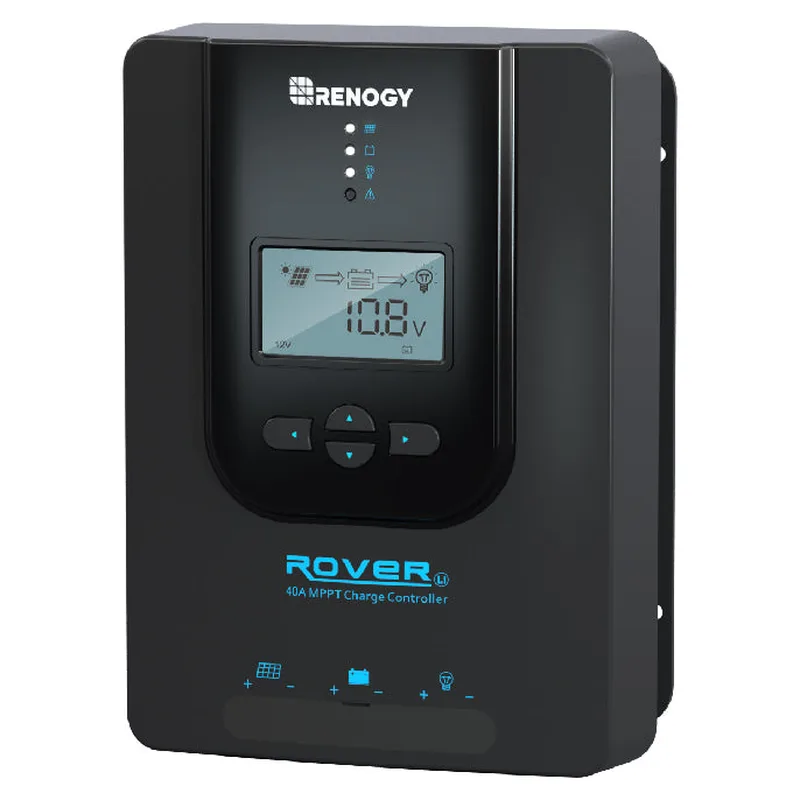
Renogy Rover 40A MPPT Solar Charge Controller (12/24 V)
40 A; 100 V max panel input; 520 W (12 V) / 1,040 W (24 V); LCD; temperature sensor included; optional BT-2 Bluetooth; 3-year warranty. $168.99 on Amazon on Nov 14, 2026.
Check price on Amazon2. EPEVER Tracer4210AN G3: Best Value
EPEVER lists the same 40 A and 520/1,040 W ratings, an MPPT input range of battery voltage plus 2 V up to 72 V, “higher than 99.5%” tracking efficiency, up to 98% conversion efficiency and self-consumption under 10 mA, which matters for a battery that sits for weeks. It supports lithium and lead-acid batteries, has an LCD for settings, a common-negative design and an RS485 port for EPEVER’s optional Wi-Fi or 4G modules, PC software or remote meter (EPEVER).
Know before you buy: there is no Bluetooth, and EPEVER’s product page does not state the warranty term or whether a battery temperature sensor is included. Its full 100 V input applies only at its coldest rated temperature (92 V at 77°F), so leave extra voltage margin. The enclosure is IP30: indoors only.
We may earn a commission if you buy through these links, at no extra cost to you. Products are chosen on published specifications; we do not test them in-house (how we choose).
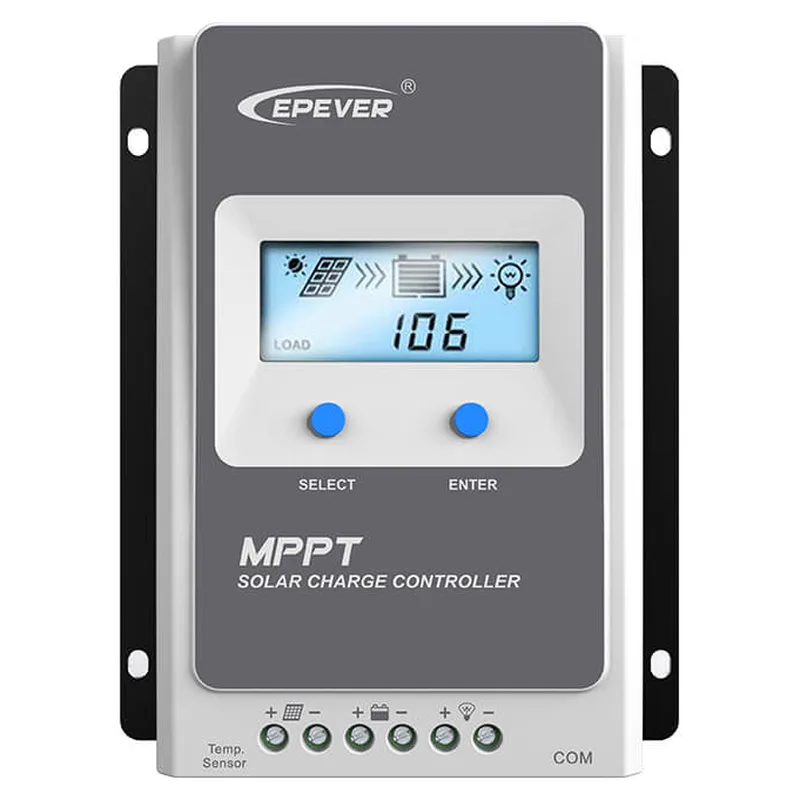
EPEVER Tracer4210AN G3 40A MPPT Charge Controller
40 A; 100 V max panel input (92 V at 77°F); 520 W (12 V) / 1,040 W (24 V); LCD; under 10 mA self-consumption; RS485. $118.99 on Amazon on Nov 14, 2026.
Check price on Amazon3. Victron SmartSolar 100/30: Best Phone App, Built In
Victron’s manual describes “built-in Bluetooth”, so you monitor and configure it in the free VictronConnect app. Victron says it works with lithium, AGM, gel and flooded batteries with a charging profile for each (Victron), and the rotary switch has a LiFePO4 position with 14.2 V absorption on 12 V (manual). Victron lists self-consumption of 30 mA at 12 V, 98% maximum efficiency, an operating range of −30 to +60°C with full output up to 40°C, and a 5-year standard warranty (specifications, product page).
Know before you buy: it is a 30 A controller, so it suits up to about 440 W of panels on 12 V; for 400 W or more on 12 V look at the 40 A picks above or Victron’s larger 100/50. It has no screen and no physical load terminals (Victron offers a virtual load output instead, per its manual). Victron also warns that a panel short-circuit current above 35 A can damage the controller if the panels are connected with reversed polarity.
We may earn a commission if you buy through these links, at no extra cost to you. Products are chosen on published specifications; we do not test them in-house (how we choose).
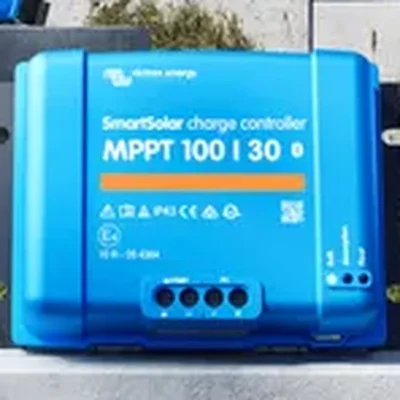
Victron SmartSolar MPPT 100/30 with Bluetooth
30 A; 100 V max panel input; 440 W (12 V) / 880 W (24 V) nominal; built-in Bluetooth and VictronConnect app; LiFePO4 preset; 5-year warranty. Check today’s price on Amazon.
Check price on AmazonBefore You Install
- Follow the manual. Use the connection order, wire gauge and fuse or breaker sizes in your controller’s manual; it covers the battery side and, for parallel strings, the panel side.
- Set the battery type. Pick the LiFePO4 or lithium setting and the voltages your battery maker specifies; see our 12V LiFePO4 battery guide.
- Respect the 100 V limit on the coldest day (step 2), and keep the controller dry and ventilated.
Free: Home Energy Audit Checklist (PDF)
A two-page, room-by-room checklist for finding air leaks, standby power and heating and cooling waste yourself, in the order that pays back fastest. Free to download, no sign-up needed.
Download the checklist (PDF)Frequently Asked Questions
What size solar charge controller do I need?
Divide your panel watts by the battery voltage for a rough charge current: 400 W on a 12 V battery is about 33 A, so choose a 40 A controller. Then check that the panels’ cold-weather open-circuit voltage stays under the controller’s limit, 100 V for all three picks here.
Is MPPT better than PWM?
An MPPT controller converts higher panel voltage into extra charging current, so panels can be wired in series. A PWM controller connects the panels straight to the battery, so the panels’ voltage should be matched to the battery. MPPT costs more but suits larger or series-wired arrays.
Can a 40A charge controller handle 600 watts?
Not on a 12 V battery by the makers’ ratings: Renogy and EPEVER list 520 W at 12 V for their 40 A controllers. On a 24 V battery the same controllers are rated for 1,040 W.
Do these work with LiFePO4 batteries?
Yes. Renogy says the Rover can charge over-discharged lithium batteries and has you set the battery type by hand, EPEVER lists lithium support, and Victron has a LiFePO4 preset. Use the charge voltages your battery maker specifies.
Why does panel voltage go up in the cold?
Solar cells produce higher open-circuit voltage at lower temperatures. Panel datasheets give a temperature coefficient for Voc, which you use to work out the highest voltage your series string can reach on the coldest morning.
Related Guides
- Best small solar panel kits — panels, some with a controller included
- Best 12V LiFePO4 battery — what the controller charges
- Best portable power station — an all-in-one alternative