EcoGuide · Solar & Storage · Published 2026-11-14 · 1,700 words
The Best Small Solar Panel Kits for RVs, Sheds and Off-Grid Use
Check today’s prices
Prices on Amazon change often. As an Amazon Associate we earn from qualifying purchases, at no extra cost to you.
The Short Answer
A solar kit makes power only while the sun is up; to use it at night you also need somewhere to store it. That is either a 12-volt battery, which these kits charge through their charge controller, or a portable power station, which has its own controller built in. Neither kit here includes a battery or an inverter for 120-volt outlets.
- Best complete kit: Renogy 400W Starter Kit. Four 100 W panels and a Rover 40A MPPT controller (Renogy). MPPT gets more of the panels’ power into the battery than a basic PWM controller, and the Rover lists support for lithium batteries.
- Budget 200 W kit: ECO-WORTHY 200W. Two 100 W panels, a 30A PWM controller, cables and brackets for $189.99 on Amazon on November 14. Wire the panels in parallel on a 12-volt system: see the warning below.
- Best panel to add to a power station: BougeRV 200W N-Type. A single rigid panel, no controller, with an open-circuit voltage of 36.4 V that fits the 60-volt solar inputs on the stations in our portable power station guide (BougeRV).
| Renogy 400W Starter Kit | ECO-WORTHY 200W Kit | BougeRV 200W Panel | |
|---|---|---|---|
| Panels | 4 × 100 W rigid | 2 × 100 W mono | 1 × 200 W N-type rigid |
| Charge controller | Rover 40A MPPT | 30A PWM | None (panel only) |
| Controller PV limit | 100 V; 520 W at 12 V, 1,040 W at 24 V | under 50 V | – |
| Panel Voc / Vmp | Not on the kit page | 24.5 V / 20.2 V each | 36.4 V / 31 V |
| Also in the box | Z-brackets, 20 ft 10 AWG adaptor kit, tray cables, Y-connectors | Z-brackets, 16.4 ft extension cable, Y-connector, tray cable | – |
| Warranty (maker) | Controller 3 years | Panels: 25-year linear power guarantee | 10 years materials; 30-year linear power |
| Amazon, Nov 14, 2026 | $599.99 | $189.99 | $219.99 |
Specifications from each maker’s own pages, checked November 14, 2026: Renogy kit, Renogy Rover, ECO-WORTHY and BougeRV. Amazon prices and contents checked by hand on November 14, 2026, all sold by the brand’s own Amazon store; the Renogy listing also included a Bluetooth module. Prices change often, so check the listing. We compare published specifications and do not test products in-house (how we choose).
How Much Power Will You Get?
A panel’s watt rating is its output under standard test conditions, not what it makes on your roof. Real output depends on how many hours of strong sun you get, the season, the angle, shade and heat. For an estimate for your ZIP code, NREL’s free PVWatts calculator works for small systems too: enter the panel watts and your location.
PWM or MPPT? A PWM controller connects the panel almost directly to the battery, so the panel works at roughly battery voltage and some of its power is left unused. An MPPT controller converts the panel’s higher voltage into extra charging current. Renogy says its MPPT controller transfers power up to 30% more efficiently than PWM controllers; how much you gain depends on conditions. MPPT matters most on bigger arrays and in cold weather; for 200 W on a 12-volt battery, PWM is a reasonable budget choice.
1. Renogy 400W Starter Kit: Best Complete Kit
Renogy’s kit (model RNG-KIT-STARTER400D-RVR40) includes four 100 W rigid panels, a Rover 40A MPPT controller, Z-brackets, a 20 ft 10 AWG solar adaptor kit, battery tray cables and three pairs of Y-branch connectors (Renogy). Renogy lists the Rover with a 100 V maximum open-circuit input, up to 520 W of panels on a 12-volt battery or 1,040 W on 24 volts, 4-stage charging, a remote temperature sensor in the box, and support for charging lithium batteries (Rover specs).
Choose it if you are building a 12-volt system for an RV, van or shed and want room to grow: the controller has headroom above the kit’s 400 W. Before you wire it: the kit page does not list the panels’ open-circuit voltage, so read it off the panel label and keep any series string, plus a margin for cold mornings, under the Rover’s 100 V. You still need a battery, fuses or breakers sized per Renogy’s manual and, for 120-volt outlets, an inverter.
We may earn a commission if you buy through these links, at no extra cost to you. Products are chosen on published specifications; we do not test them in-house (how we choose).
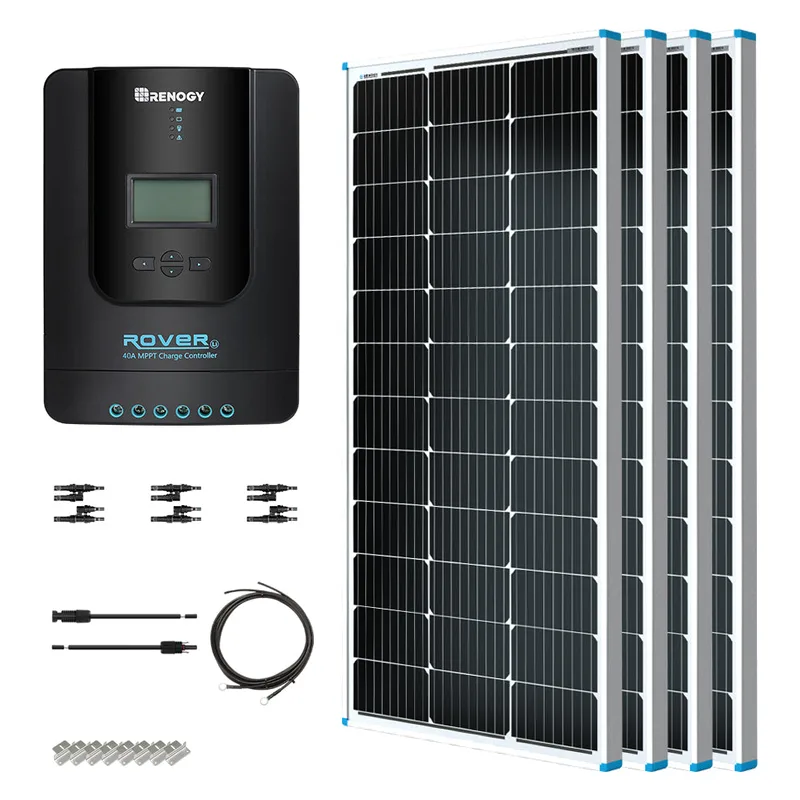
Renogy 400W 12V Solar Starter Kit (Rover 40A MPPT)
4 × 100 W panels; Rover 40A MPPT (100 V max input); brackets and cables. $599.99 on Amazon on Nov 14, 2026, with a Bluetooth module.
Check price on Amazon2. ECO-WORTHY 200W Kit: Budget Pick
Two 100 W monocrystalline panels (20.2 V at maximum power, 24.5 V open-circuit, 11.46 lb each), a 30A PWM controller with a 5V/2A USB port, a 16.4 ft MC4 extension cable, Z-brackets, a Y-connector and a tray cable (ECO-WORTHY). ECO-WORTHY rates the panels for a 25-year linear power guarantee and says the kit can be wired in series for 24 volts or in parallel for 12 volts.
The wiring warning: the controller is rated for under 50 V of panel open-circuit voltage. Two panels in series give 49.0 V at 77°F, and ECO-WORTHY lists a voltage temperature coefficient of −0.38% per °C, so at 14°F (35°C colder) that rises by about 13%, to roughly 55.5 V: above the controller’s limit. On a 12-volt battery, use the included Y-connector and wire the panels in parallel, which keeps the input near 24.5 V. ECO-WORTHY’s page does not list the controller’s supported battery types, so check the manual before using it with a lithium battery.
We may earn a commission if you buy through these links, at no extra cost to you. Products are chosen on published specifications; we do not test them in-house (how we choose).

ECO-WORTHY 200W 12V/24V Solar Panel Kit (30A PWM)
2 × 100 W panels; 30A PWM controller (under 50 V input); cables and Z-brackets. $189.99 on Amazon on Nov 14, 2026.
Check price on Amazon3. BougeRV 200W N-Type Panel: Best for a Power Station
A single 200 W rigid panel with N-type TOPCon cells, which BougeRV rates at 25% cell efficiency, and 24 bypass diodes that it says keep up to 85% of output in partial shade (BougeRV). Electrical specs: 31 V and 6.45 A at maximum power, 36.4 V open-circuit. It weighs 23.4 lb and measures 50.2 × 30.3 × 1.2 inches. BougeRV gives a 10-year materials warranty and a 30-year linear power warranty.
Why it suits a power station: one panel’s 36.4 V sits well inside the 60-volt solar inputs of the Anker, EcoFlow and Jackery stations we compared; even at 14°F, with BougeRV’s −0.25% per °C coefficient, it is about 39.6 V. Do not put two in series on those stations: 72.8 V is over their limit. It is panel only, with no controller or mounts, so check that your station accepts its connector or buy the right adapter.
We may earn a commission if you buy through these links, at no extra cost to you. Products are chosen on published specifications; we do not test them in-house (how we choose).
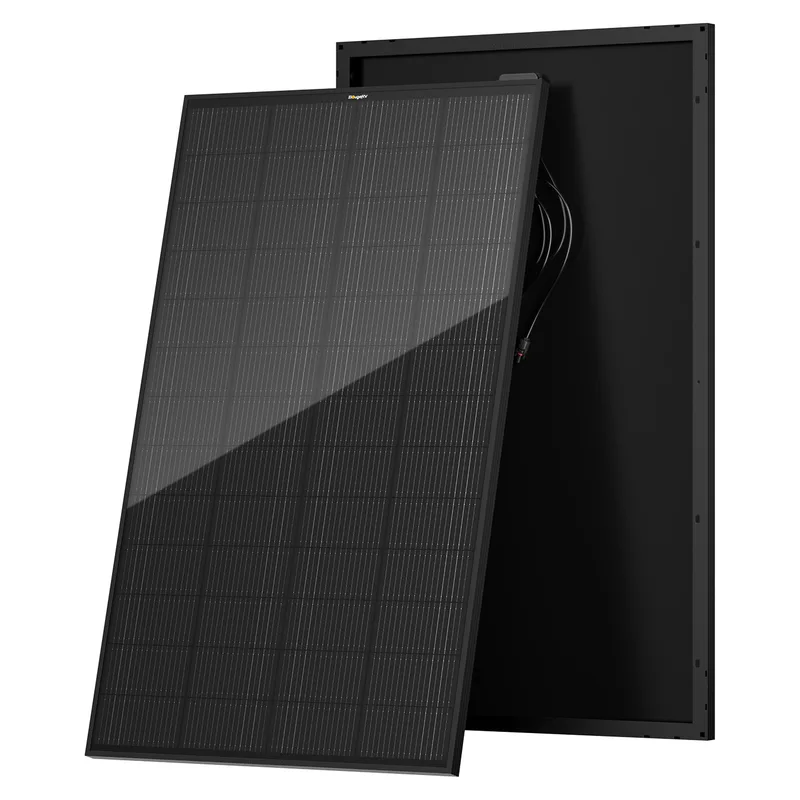
BougeRV 200W ShadePower N-Type Rigid Solar Panel
200 W N-type rigid panel; 36.4 V open-circuit; 24 bypass diodes; 23.4 lb. Panel only. $219.99 on Amazon on Nov 14, 2026.
Check price on AmazonSafe Setup, in Plain Terms
- Respect the controller’s voltage limit, with a cold-weather margin. Panel voltage rises as temperature falls; the coldest morning sets your highest voltage.
- Fuse or breaker every battery connection as the controller manual specifies; battery cables can carry very high current in a fault.
- Match the controller’s battery setting to your battery chemistry (lead-acid, AGM or lithium).
- Anything tied into a home’s wiring needs a licensed electrician and, in most places, a permit. These kits are for RVs, sheds and stand-alone 12-volt systems.
Free: Home Energy Audit Checklist (PDF)
A two-page, room-by-room checklist for finding air leaks, standby power and heating and cooling waste yourself, in the order that pays back fastest. Free to download, no sign-up needed.
Download the checklist (PDF)Frequently Asked Questions
Do solar panel kits come with a battery?
Not these. The Renogy and ECO-WORTHY kits include panels, a charge controller, brackets and cables; the battery and any inverter are extra. The BougeRV is a single panel.
Is MPPT worth it over PWM?
For larger arrays, 24-volt systems and cold climates, usually yes: an MPPT controller turns the panel’s extra voltage into charging current. Renogy says up to 30% more efficient than PWM. For a small 200 W kit on a 12-volt battery, PWM is a reasonable budget choice.
Can I connect solar panels directly to a portable power station?
Yes, if the panel’s open-circuit voltage and wattage are within the station’s solar input limits and the connector matches. One BougeRV 200W panel (36.4 V) fits 60-volt inputs; two in series (72.8 V) do not.
Should I wire the ECO-WORTHY panels in series or parallel?
On a 12-volt battery, in parallel. In series they reach 49 V at 77°F and about 55 V on a 14°F morning, above the included controller’s 50 V limit.
How much power will a 400W solar kit make?
It depends on your location, season, angle and shade. Use NREL’s free PVWatts calculator with 400 W and your ZIP code for an estimate.
Related Guides
- Best 12V LiFePO4 batteries — store what the panels make
- Best MPPT solar charge controller — upgrade or size a controller
- Best portable power station for home backup — charge one from these panels
- Home energy storage — batteries and peak shaving
- Solar panels but the bill is still high — for rooftop systems
- Best home energy monitors — see where the power goes