EcoGuide · Lighting Efficiency · Updated 2026-10-14 · 1,200 words
LED vs Incandescent: What Switching Actually Saves, With the Math
The Short Answer
An LED gives the same light for a fraction of the power. The Department of Energy says residential LEDs use at least 75% less energy, and last up to 25 times longer than incandescent lighting, and that the average household saves about $225 in energy costs per year by using LED lighting.
Per bulb, at the EIA’s 2025 U.S. average price per kWh, swapping a 60-watt incandescent for its LED equivalent saves about $10 a year if the light is on three hours a day. The table below shows the working, so you can redo it with your own rate, or use our LED savings calculator.
The Sum, Bulb by Bulb
Cost per year = watts × hours per day × 365 ÷ 1,000 × your price per kWh. The table uses three hours a day and 17.3 cents per kWh, the Energy Information Administration’s U.S. residential average for 2025. LED wattages are taken from within the ranges in the Department of Energy’s purchasing guide. The dollar figures are our own arithmetic.
| Old bulb | LED for the same light | Incandescent, per year | LED, per year | Saved per bulb, per year |
|---|---|---|---|---|
| 40 W (450 lumens) | about 6 W | $7.58 | $1.14 | $6.44 |
| 60 W (800 lumens) | about 9 W | $11.37 | $1.70 | $9.66 |
| 75 W (1,100 lumens) | about 11 W | $14.21 | $2.08 | $12.12 |
| 100 W (1,600 lumens) | about 14 W | $18.94 | $2.65 | $16.29 |
Twenty 60-watt bulbs at three hours a day comes to about $193 a year, which sits close to the Department of Energy’s $225 household figure. Lights that are on longer save more; a closet light saves almost nothing. Start with the fixtures you use most.
How Big Is Lighting on the Bill?
Smaller than it used to be, because most homes have already switched some bulbs. The Energy Information Administration estimates that in 2020 lighting accounted for about 6% of electricity consumption in U.S. homes. The Department of Energy uses an older figure of around 15% for an average home. If your home still has mostly incandescent or halogen bulbs, you are nearer the higher number and have the most to gain.
Buy by Lumens, Not Watts
Watts measure power used, not light. ENERGY STAR’s guide: brightness is a description of light output, which is measured in lumens (not watts). To replace a bulb, match the lumens:
| Old incandescent | Lumens to look for | Typical LED wattage |
|---|---|---|
| 40 W | 450 | 4.5 to 7 W |
| 60 W | 800 | 5.9 to 10.5 W |
| 75 W | 1,100 | 9.5 to 14 W |
| 100 W | 1,600 | 10.5 to 18 W |
| 150 W | 2,600 | — |
Then choose the color. Lower Kelvin numbers are warmer and yellower; 2700K is the usual warm white that looks like an incandescent. Higher numbers are cooler and bluer.
Three Things to Check on the Box
- Dimmable. The Department of Energy: many LED bulbs can be used with dimmers, but they must be designed for dimming. If it does not say dimmable, it is not.
- Enclosed fixtures. The Department of Energy’s purchasing guide warns that fully enclosed fixtures trap heat, which can shorten the life of some LED products. Look for a bulb rated for enclosed fixtures.
- The ENERGY STAR label is no longer on bulbs. The EPA ended its ENERGY STAR specification for light bulbs on December 31, 2024, so current packaging will not carry it. Use the Lighting Facts panel on the box instead: it lists lumens, watts, life and light color.
Can You Still Buy Incandescent Bulbs?
Not the ordinary ones. The federal efficiency standard for common household bulbs is 45 lumens per watt, which a traditional incandescent (about 13 lumens per watt for a 60-watt bulb) cannot meet. Some specialty bulbs, such as appliance bulbs, are outside the rule. A Department of Energy rule finalized in April 2024 would raise the standard to more than 120 lumens per watt for the most common bulbs, with manufacturer compliance from July 25, 2028; that date could still change.
What About CFLs?
Compact fluorescents were the first efficient replacement and many homes still have them. They contain a small amount of mercury: the EPA says about four milligrams on average, sealed in the glass. That is why a broken one needs care; the EPA’s clean-up steps start with airing the room and not using a vacuum cleaner. When a CFL fails, replace it with an LED, which the Department of Energy says lasts three to five times longer.
LED Bulbs to Start With
Standard A19 bulbs for ordinary lamps and fixtures. Check lumens and color on the listing against the tables above.
We may earn a commission if you buy through these links, at no extra cost to you. Products are chosen on published specifications; we do not test them in-house (how we choose).
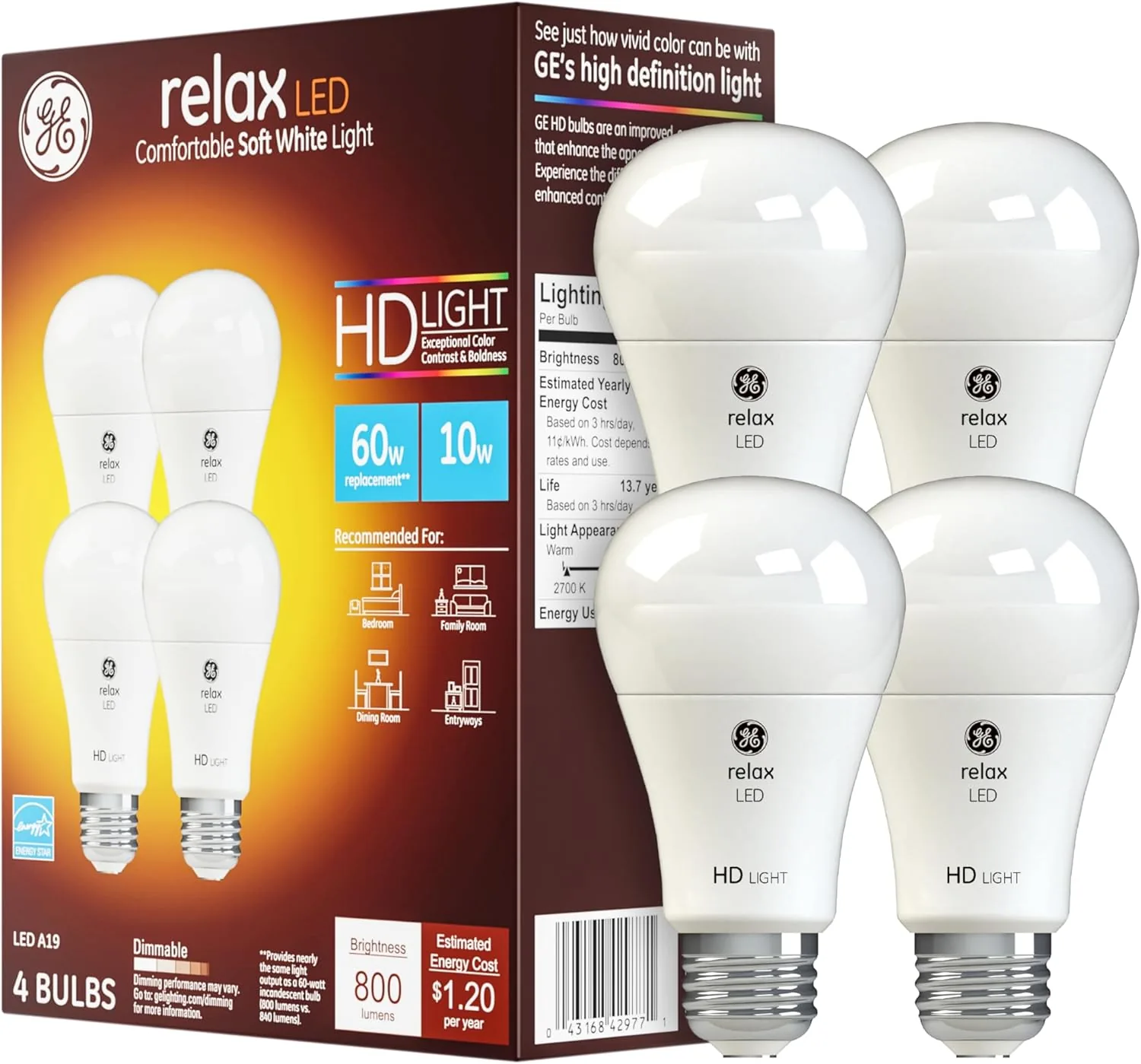
GE Relax LED A19 4-Pack
Soft white A19 bulbs; a straightforward swap for living rooms and bedrooms.
Check price on Amazon
Amazon Basics A19 LED 60W Equivalent (16-Pack)
A sixteen-pack of 9 W, 60 W-equivalent bulbs for doing a whole floor at once.
Check price on AmazonFree: Home Energy Audit Checklist (PDF)
A two-page, room-by-room checklist for finding air leaks, standby power and heating and cooling waste yourself, in the order that pays back fastest. Get it now, plus new fix guides by email. Unsubscribe any time.
By signing up you agree to receive emails from EcoHome Intelligence. See our Privacy Policy.
Frequently Asked Questions
How much do LED bulbs save compared with incandescent?
At the 2025 U.S. average price of 17.3 cents per kWh and three hours a day, replacing a 60-watt incandescent with a 9-watt LED saves about $9.66 a year per bulb. The Department of Energy puts the average household saving from LED lighting at about $225 a year.
How much less energy does an LED use?
At least 75% less than incandescent lighting, according to the Department of Energy, and it lasts up to 25 times longer.
What LED replaces a 60-watt bulb?
One that gives about 800 lumens. The Department of Energy's purchasing guide puts that at 5.9 to 10.5 watts for an LED.
Are incandescent bulbs banned?
Ordinary ones can no longer meet the federal standard of 45 lumens per watt for common household bulbs. Some specialty bulbs are outside the rule.
Do LED bulbs work with dimmers?
Only if they are designed for dimming; check the packaging.
Why can't I find ENERGY STAR on light bulbs any more?
The EPA ended the ENERGY STAR specification for light bulbs on December 31, 2024. Use the Lighting Facts panel on the box to compare bulbs.
Related Guides
- Motion sensors vs smart bulbs — for lights that get left on
- How to install a motion sensor switch — a one-hour upgrade
- Electric bill doubled in two years? — finding the bigger loads
- Home energy audit checklist — a two-page printable
Sources
- U.S. Department of Energy: LED lighting
- U.S. Department of Energy: Lighting choices to save you money
- U.S. Department of Energy FEMP: Purchasing energy-efficient light bulbs
- U.S. Department of Energy: Lighting controls
- EIA: Short-Term Energy Outlook, residential electricity price (Sept 2026)
- EIA: How much electricity is used for lighting?
- ENERGY STAR: Learn about brightness
- EPA: ENERGY STAR lighting sunset memo (Dec 2024, PDF)
- U.S. Department of Energy: Efficiency standards for lightbulbs (April 2024)
- EPA: Mercury and CFLs
- EPA: Cleaning up a broken CFL
