EcoGuide · Insulation · Published 2026-11-14 · 1,500 words
Attic Radiant Barriers: When They Work and How to Install One Correctly
Check today’s prices
Prices on Amazon change often. As an Amazon Associate we earn from qualifying purchases, at no extra cost to you.
The Short Answer
A radiant barrier is a sheet of highly reflective material, usually stapled under the roof rafters, that reflects the heat a hot roof radiates down into the attic. The U.S. Department of Energy (DOE) says barriers are “more effective in hot climates than in cool climates, especially when cooling air ducts are located in the attic,” and that some studies show they can cut cooling costs 5% to 10% in a warm, sunny climate (DOE).
- Worth considering if you live somewhere hot and sunny, pay mainly for air conditioning, and especially if your ducts or air handler sit in the attic.
- Usually not worth it in a cool climate: DOE says it is “usually more cost-effective to install more thermal insulation” there.
- It is not insulation. A radiant barrier does not slow heat conduction the way insulation does, so it adds to, and does not replace, proper attic insulation and air sealing.
- It must face an air space to work, and DOE strongly recommends not laying it directly on top of attic floor insulation.
Figures and installation rules on this page come from DOE’s Energy Saver guide and the makers’ own pages, checked November 14, 2026. We compare published information and do not test products in-house (how we choose).
How a Radiant Barrier Works
On a sunny day the roof heats up and radiates heat down onto everything in the attic: the insulation, the ducts and the ceiling below. A radiant barrier reflects most of that radiant heat back instead of absorbing it. DOE notes three conditions for it to work well: the reflective surface must face an air space, it works best when it is perpendicular to the radiant energy hitting it, and the bigger the temperature difference across it, the more it helps (DOE).
That is also why it does little in winter in cold climates and why dust ruins it: a dusty foil surface reflects much less heat.
Is It Worth It Where You Live?
| Your situation | What DOE’s guidance points to |
|---|---|
| Hot, sunny climate; ducts in the attic | Best case for a radiant barrier: DOE cites 5% to 10% lower cooling costs in some studies |
| Hot climate; ducts inside the house | Can still help, but DOE singles out ducts in the attic as the strongest case |
| Cool climate, heating-dominated bills | Add insulation first; DOE says it is usually more cost-effective |
| Attic insulation below recommended levels | Insulate and air-seal first; a barrier does not replace either |
If upstairs rooms are the problem, see our guide to cooling an upstairs that is hotter than downstairs, which covers duct and airflow fixes that often matter more.
How to Install One Correctly
- Staple it to the underside of the rafters. DOE describes retrofits done from inside the attic by stapling the material to the bottom of the rafters, letting it droop between staples so there is “at least a 1.0 inch (2.5 cm) air space” between the foil and the underside of the roof (DOE). AtticFoil says to keep an air gap of at least 1/2 inch on one side (AtticFoil).
- Leave ventilation paths open. AtticFoil recommends stopping the foil about 3 to 6 inches short of the eaves and of the roof peak, so air from soffit vents can still reach ridge vents (AtticFoil).
- Do not lay it on the attic floor insulation. DOE strongly recommends against this: the foil collects dust, which cuts its reflectivity, and it may trap moisture in the insulation below (DOE).
- Use a perforated product in a vented attic. Both picks below are perforated. AtticFoil says that where moisture can build up, such as a vented attic, you want a perforated product, not a solid vapor barrier (AtticFoil).
- Stay clear of wiring. DOE warns that “reflective foil will conduct electricity,” so avoid contact with bare electrical wiring. Check local building and fire codes before you start, or hire a certified installer as DOE recommends.
How much to buy: measure the underside of each roof plane you will cover (rafter length from eave to ridge times the length of the roof) and add a little for waste. A 500 sq ft roll suits a small attic or one roof plane at a time; larger attics usually need 1,000 sq ft or more.
1. Reflectix Radiant Barrier: Best for a Typical Attic
Reflectix’s RB4812550 is two outer layers of 96% reflective metalized film bonded around a woven polyethylene fabric, and it is perforated. Reflectix’s technical sheet lists an emittance of 0.04, a Class A / Class 1 fire rating (ASTM E84 flame spread under 25, smoke developed under 50), a permeance of 6.3 perms and a weight of 15 lb per 500 sq ft (Reflectix technical sheet). One roll is 48 inches by 125 feet, 500 sq ft (Reflectix).
Know before you buy: Reflectix does not give an R-value for this product; it says benefits “vary per application.” At $120.65 on Amazon on November 14, it works out to about $0.24 per sq ft.
We may earn a commission if you buy through these links, at no extra cost to you. Products are chosen on published specifications; we do not test them in-house (how we choose).

Reflectix Radiant Barrier RB4812550 (48 in × 125 ft, 500 sq ft)
Perforated; 96% reflective film over woven polyethylene; emittance 0.04; Class A / Class 1 fire rating; 500 sq ft. $120.65 on Amazon on Nov 14, 2026, sold by Reflectix.
Check price on Amazon2. AtticFoil Perforated Radiant Barrier: Best for Large Attics
AtticFoil’s 48-inch heavyweight foil is double-sided, made of “100% PURE aluminum” rather than metalized film, and micro-perforated so it breathes. It weighs 28.6 lb per 1,000 sq ft, and AtticFoil sells it in 250, 500 and 1,000 sq ft rolls; the 1,000 sq ft roll is 48 inches by 250 feet (AtticFoil). AtticFoil advertises a lifetime warranty (AtticFoil). The bigger roll also costs less per square foot: about $0.21, against $0.24 for the Reflectix roll at November 14 Amazon prices.
Know before you buy: AtticFoil’s product page does not list a fire rating, perm rating or emissivity figure; ask for its technical sheet if your local code requires one.
We may earn a commission if you buy through these links, at no extra cost to you. Products are chosen on published specifications; we do not test them in-house (how we choose).
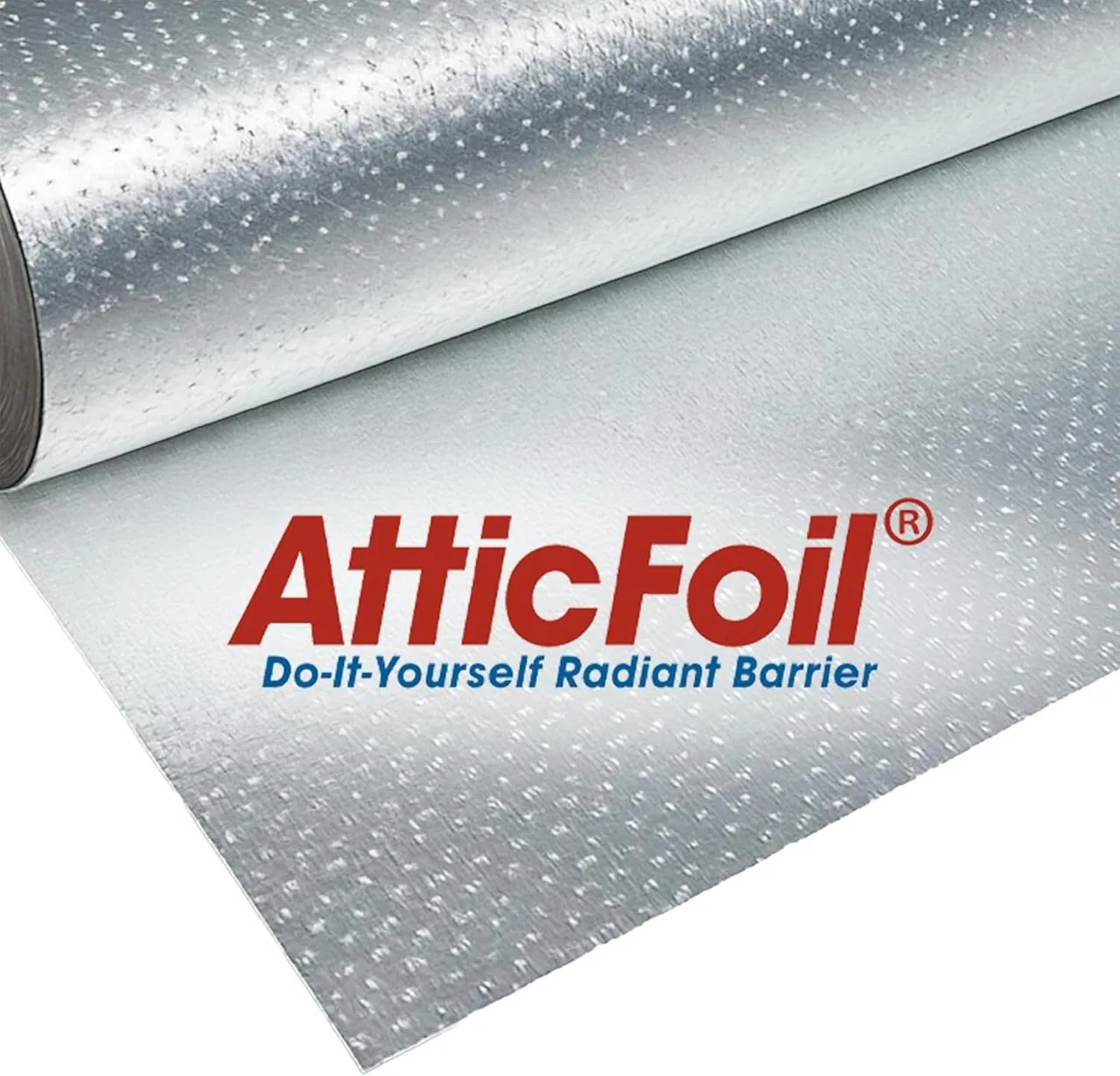
AtticFoil Perforated Radiant Barrier (48 in, 1,000 sq ft)
Double-sided aluminum; perforated; heavyweight (28.6 lb per 1,000 sq ft); 48 in × 250 ft. $213.99 on Amazon on Nov 14, 2026, sold by AtticFoil, about $0.21 per sq ft.
Check price on AmazonFree: Home Energy Audit Checklist (PDF)
A two-page, room-by-room checklist for finding air leaks, standby power and heating and cooling waste yourself, in the order that pays back fastest. Free to download, no sign-up needed.
Download the checklist (PDF)Frequently Asked Questions
Does a radiant barrier really lower cooling bills?
In the right climate. DOE says some studies show radiant barriers can reduce cooling costs 5% to 10% in a warm, sunny climate, with the biggest benefit when cooling ducts run through the attic. In cool climates DOE says more insulation is usually more cost-effective.
Does a radiant barrier help in winter?
DOE describes radiant barriers mainly as a way to reduce summer heat gain and cooling costs. In cool climates it recommends adding insulation instead.
Can I put a radiant barrier on top of my attic insulation?
DOE strongly recommends against it: foil laid on the attic floor collects dust, which reduces its reflectivity, and it may trap moisture in the insulation. Staple it under the rafters instead.
How big an air gap does a radiant barrier need?
DOE says to let the foil droop so there is at least a 1.0 inch (2.5 cm) air space between it and the underside of the roof. AtticFoil gives a minimum of 1/2 inch on one side.
Is a radiant barrier the same as insulation?
No. A radiant barrier reflects radiant heat; it does not reduce conducted heat like insulation does. Reflectix does not publish an R-value for its radiant barrier roll.
Perforated or solid radiant barrier?
For a vented attic, perforated. AtticFoil says that where moisture can build up, such as a vented attic, you want a perforated product rather than a solid vapor barrier. Both picks here are perforated.
Related Guides
- Upstairs hotter than downstairs? — fixes that often matter more
- Are solar attic fans worth it? — what the research found
- Attic insulation — check yours first
- Attic air sealing cost — what fair pricing looks like
- Seal the attic hatch — a cheap first fix